
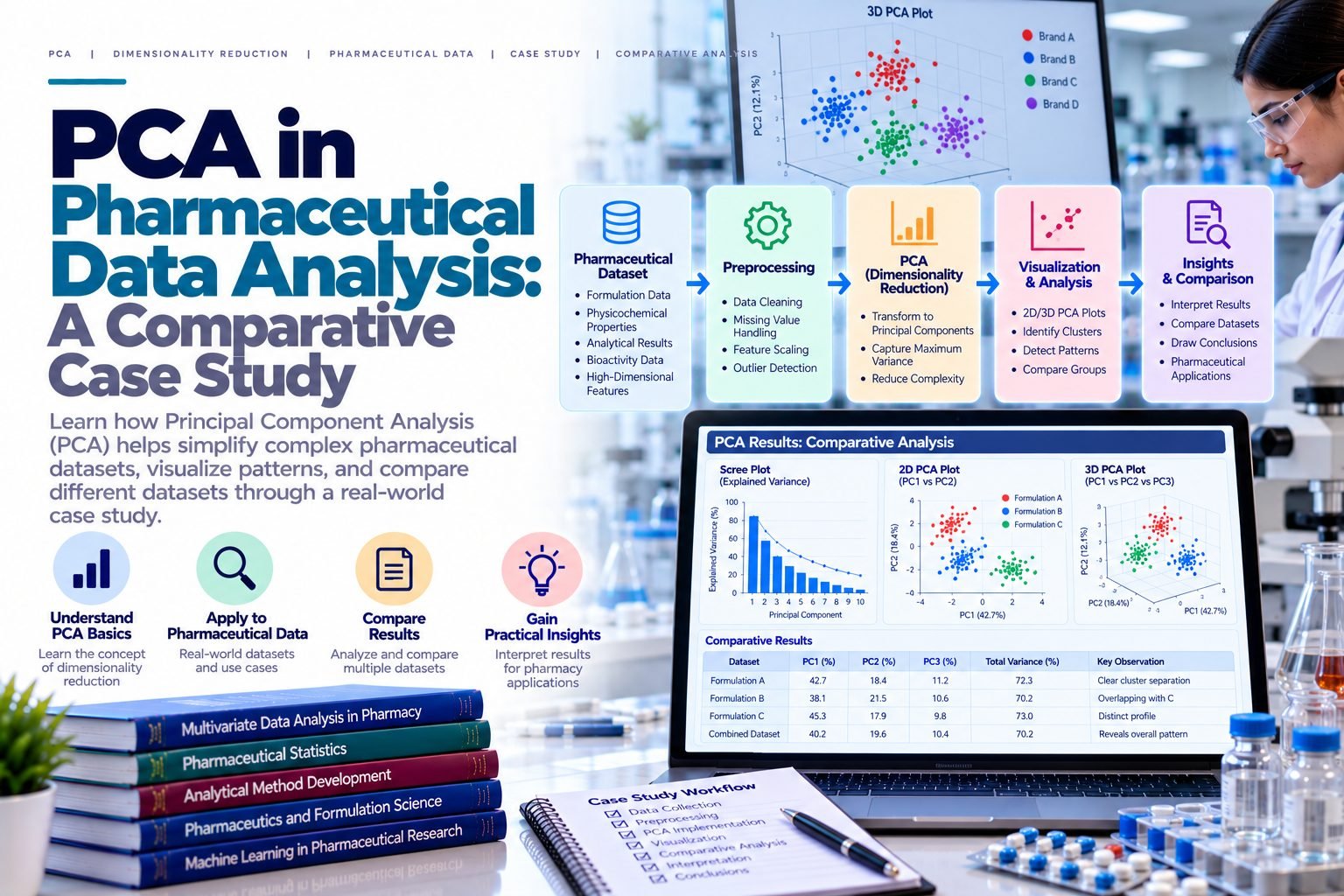
Introduction — why the comparison matters
Principal Component Analysis (PCA) is a widely used dimensionality reduction technique in pharmaceutical data analysis. It helps in reducing the complexity of high-dimensional data while retaining most of the information. In the context of pharmaceutical data, PCA can be applied to various types of data, including gene expression, spectroscopic, and clinical trial data. The purpose of this article is to provide a comparative case study of PCA in pharmaceutical data analysis with a focus on feature engineering.
Quick side-by-side summary
A quick comparison of PCA with other dimensionality reduction techniques, such as t-SNE and Autoencoders, reveals that PCA is a simple yet effective method for reducing dimensionality while preserving the global structure of the data. The following table summarizes the key differences between these techniques:
- PCA: Linear, preserves global structure, simple to implement
- t-SNE: Non-linear, preserves local structure, computationally expensive
- Autoencoders: Non-linear, learns complex representations, requires large datasets
Deep dive A: PCA for feature extraction
PCA can be used for feature extraction in pharmaceutical data analysis. By applying PCA to a dataset, the resulting principal components can be used as new features that capture the most variance in the data. For example, in a study on gene expression data, PCA was used to extract features that differentiated between cancer and normal cells. The resulting principal components were used as input to a machine learning model, which achieved high accuracy in predicting cancer diagnosis.
from sklearn.decomposition import PCA
from sklearn.datasets import load_breast_cancer
from sklearn.model_selection import train_test_split
from sklearn.ensemble import RandomForestClassifier

# Load breast cancer dataset
data = load_breast_cancer()
X = data.data
y = data.target

# Apply PCA to extract features
pca = PCA(n_components=2)
X_pca = pca.fit_transform(X)

# Split data into training and testing sets
X_train, X_test, y_train, y_test = train_test_split(X_pca, y, test_size=.2, random_state=42)

# Train a random forest classifier on the extracted features
rf = RandomForestClassifier(n_estimators=100)
rf.fit(X_train, y_train)

# Evaluate the model on the test set
accuracy = rf.score(X_test, y_test)
print("Accuracy:", accuracy)
Deep dive B: PCA for data visualization
PCA can also be used for data visualization in pharmaceutical data analysis. By reducing the dimensionality of high-dimensional data, PCA enables the visualization of complex relationships between variables. For example, in a study on spectroscopic data, PCA was used to visualize the relationships between different wavelengths and their corresponding intensities. The resulting plot revealed clusters of similar spectra, which corresponded to different chemical compounds.
import matplotlib.pyplot as plt
from sklearn.decomposition import PCA
from sklearn.datasets import load_iris

# Load iris dataset
data = load_iris()
X = data.data

# Apply PCA to reduce dimensionality
pca = PCA(n_components=2)
X_pca = pca.fit_transform(X)

# Plot the reduced data
plt.scatter(X_pca[:, ], X_pca[:, 1], c=data.target)
plt.xlabel("Principal Component 1")
plt.ylabel("Principal Component 2")
plt.show()
When to use which
The choice of dimensionality reduction technique depends on the specific problem and dataset. PCA is a good choice when the goal is to preserve the global structure of the data and reduce dimensionality while retaining most of the information. t-SNE and Autoencoders are better suited for preserving local structure and learning complex representations, respectively. The following scenarios illustrate when to use each technique:
- Use PCA when: The data has a clear global structure, and the goal is to reduce dimensionality while preserving most of the information.
- Use t-SNE when: The data has a complex local structure, and the goal is to preserve the relationships between nearby data points.
- Use Autoencoders when: The data has a complex representation, and the goal is to learn a compact and informative representation.
Common pitfalls in choosing
One common pitfall in choosing a dimensionality reduction technique is to overlook the specific characteristics of the dataset. For example, if the data has a clear global structure, PCA may be a good choice. However, if the data has a complex local structure, t-SNE or Autoencoders may be more suitable. Another pitfall is to choose a technique based solely on its popularity or ease of implementation, rather than its suitability for the specific problem.
Conclusion
In conclusion, PCA is a powerful technique for dimensionality reduction in pharmaceutical data analysis. Its ability to preserve the global structure of the data while reducing dimensionality makes it a popular choice for feature extraction and data visualization. However, the choice of dimensionality reduction technique depends on the specific problem and dataset. By understanding the strengths and limitations of each technique, researchers and practitioners can choose the most suitable method for their needs.
Additional Considerations
In addition to the techniques discussed above, there are several other considerations that are important when applying PCA to pharmaceutical data analysis. These include the choice of preprocessing steps, such as normalization and feature scaling, and the evaluation of the resulting models using metrics such as accuracy and precision. Furthermore, the interpretation of the results requires a deep understanding of the underlying biology and chemistry of the system being studied.
Future Directions
Future research directions in the application of PCA to pharmaceutical data analysis include the development of new techniques for feature extraction and data visualization, as well as the integration of PCA with other machine learning and statistical methods. Additionally, the increasing availability of large and complex datasets in the pharmaceutical industry presents new opportunities for the application of PCA and other dimensionality reduction techniques.