
Introduction — what we're building and why
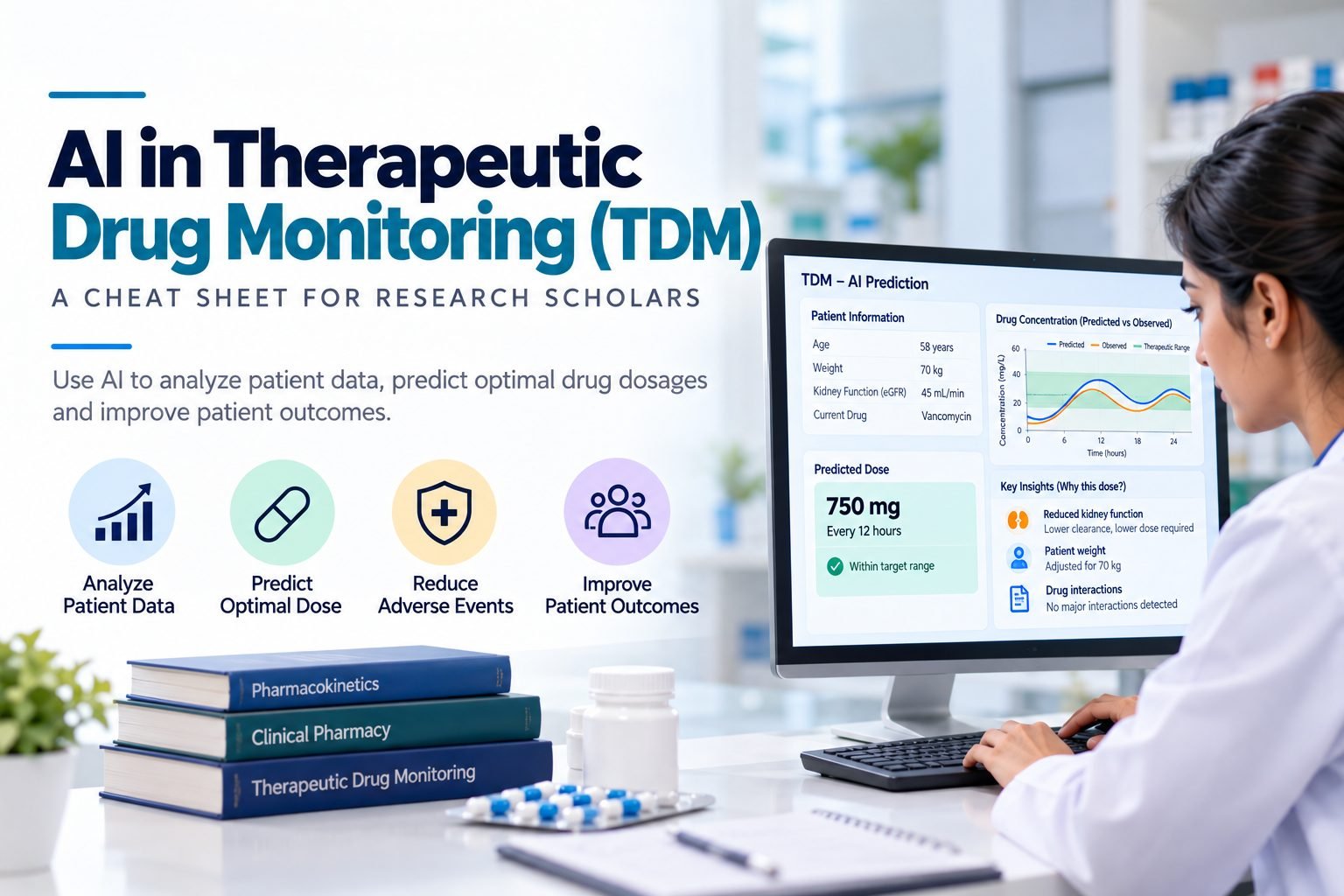
Therapeutic drug monitoring (TDM) is a crucial aspect of pharmacy practice, ensuring that patients receive the optimal dosage of medications. Artificial intelligence (AI) can enhance TDM by analyzing large datasets and identifying patterns that may not be apparent to human clinicians. In this article, we'll explore the role of AI in TDM, including code examples and comparison tables.
For instance, consider a patient with kidney disease who requires careful monitoring of their medication levels. AI can help analyze the patient's medical history, laboratory results, and medication regimen to predict the optimal dosage and minimize potential side effects.
Prerequisites
Before diving into the world of AI in TDM, it's essential to have a solid understanding of the underlying concepts. These include pharmacokinetics, pharmacodynamics, and statistical analysis. Additionally, familiarity with programming languages such as Python and R is necessary for implementing AI algorithms.
For example, a research scholar in pharmaceutical sciences may need to analyze data from a clinical trial to identify correlations between medication levels and patient outcomes. A basic understanding of statistical concepts such as regression analysis and hypothesis testing is necessary to interpret the results.
Step-by-step walkthrough with code examples
To demonstrate the application of AI in TDM, let's consider a simple example using Python and the scikit-learn library. Suppose we want to predict the optimal dosage of a medication based on a patient's age, weight, and kidney function.
import pandas as pd
from sklearn.ensemble import RandomForestRegressor
from sklearn.model_selection import train_test_split

# Load data
data = pd.read_csv('patient_data.csv')

# Split data into training and testing sets
X_train, X_test, y_train, y_test = train_test_split(data.drop('dosage', axis=1), data['dosage'], test_size=.2, random_state=42)

# Train random forest model
model = RandomForestRegressor(n_estimators=100, random_state=42)
model.fit(X_train, y_train)

# Make predictions on testing set
y_pred = model.predict(X_test)
This code snippet demonstrates how to train a random forest model to predict the optimal dosage of a medication based on patient characteristics. The model can then be used to make predictions on new, unseen data.
Common errors and how to fix them
When working with AI in TDM, common errors may arise from issues such as overfitting, underfitting, or incorrect data preprocessing. To address these errors, it's essential to carefully evaluate the model's performance using metrics such as mean squared error (MSE) or R-squared.
For instance, if the model is overfitting, it may be necessary to reduce the number of features or increase the regularization parameter. Conversely, if the model is underfitting, it may be necessary to increase the number of features or decrease the regularization parameter.
Best practices for production use
When deploying AI models in a production environment, it's crucial to follow best practices such as model validation, testing, and maintenance. This ensures that the model performs optimally and provides accurate predictions in real-world scenarios.
For example, a pharmacy may want to implement an AI-powered TDM system to optimize medication dosages for patients. To ensure the system's reliability, it's essential to validate the model using real-world data and perform regular maintenance updates to account for changes in patient populations or medication regimens.
Where to go next
As research scholars in pharmaceutical sciences, it's essential to stay up-to-date with the latest developments in AI and TDM. This may involve attending conferences, reading scientific articles, or participating in online forums to discuss the latest advancements and challenges in the field.
For instance, the American Society of Health-System Pharmacists (ASHP) offers various resources and training programs for pharmacists and researchers interested in AI and TDM. These resources provide a wealth of information on the latest techniques, tools, and best practices in the field.
Frequently Asked Questions
Here are some frequently asked questions about AI in TDM:
- Q: What is the role of AI in TDM?
- A: AI can enhance TDM by analyzing large datasets and identifying patterns that may not be apparent to human clinicians.
- Q: What programming languages are commonly used in AI for TDM?
- A: Python and R are popular programming languages used in AI for TDM.
- Q: How can I get started with AI in TDM?
- A: Start by learning the basics of pharmacokinetics, pharmacodynamics, and statistical analysis, and then explore programming languages such as Python and R.
- Q: What are some common errors in AI for TDM?
- A: Common errors include overfitting, underfitting, and incorrect data preprocessing.
- Q: How can I evaluate the performance of an AI model in TDM?
- A: Use metrics such as mean squared error (MSE) or R-squared to evaluate the model's performance.
Common Misconceptions
Here are some common misconceptions about AI in TDM:
- Myth: AI will replace human clinicians in TDM.
- Reality: AI is designed to augment human decision-making, not replace it.
- Myth: AI requires large amounts of data to be effective.
- Reality: While large datasets can be beneficial, AI can also be effective with smaller datasets.
- Myth: AI is only useful for complex TDM tasks.
- Reality: AI can be useful for both simple and complex TDM tasks.
- Myth: AI is not transparent or interpretable.
- Reality: Many AI models are designed to be transparent and interpretable, providing insights into the decision-making process.
Practical Application
To apply AI in TDM, follow these concrete steps:
- Define the problem or question you want to address.
- Collect and preprocess the relevant data.
- Choose a suitable AI algorithm or model.
- Train and validate the model using the collected data.
- Deploy the model in a production environment.
- Monitor and maintain the model's performance over time.
By following these steps, you can harness the power of AI to enhance TDM and improve patient outcomes.