
Introduction
Case report summarization is a crucial task in pharmacy, especially for regulatory affairs professionals. It involves condensing large amounts of data into a concise and meaningful summary. With the increasing volume of case reports, manual summarization has become a time-consuming and labor-intensive process. This is where Artificial Intelligence (AI) comes in – to automate case report summarization. In this article, we will explore how AI can help regulatory affairs professionals in pharmacy automate case report summarization with a decision tree approach.
What it is / what it isn't
AI for automated case report summarization is a type of Natural Language Processing (NLP) that uses machine learning algorithms to identify and extract relevant information from case reports. It is not a replacement for human judgment but rather a tool to assist regulatory affairs professionals in summarizing large amounts of data quickly and accurately. For example, a pharmaceutical company may use AI to summarize case reports of adverse events related to a new drug, allowing them to identify potential safety issues more efficiently.
Why it matters for the target audience
Regulatory affairs professionals in pharmacy play a critical role in ensuring the safety and efficacy of drugs. They must review and analyze large amounts of data, including case reports, to identify potential safety issues and make informed decisions. AI for automated case report summarization can help them save time and resources, allowing them to focus on higher-level tasks such as data analysis and decision-making. For instance, a regulatory affairs professional may use AI to summarize case reports of drug interactions, enabling them to identify potential safety risks and develop strategies to mitigate them.
Key components or steps
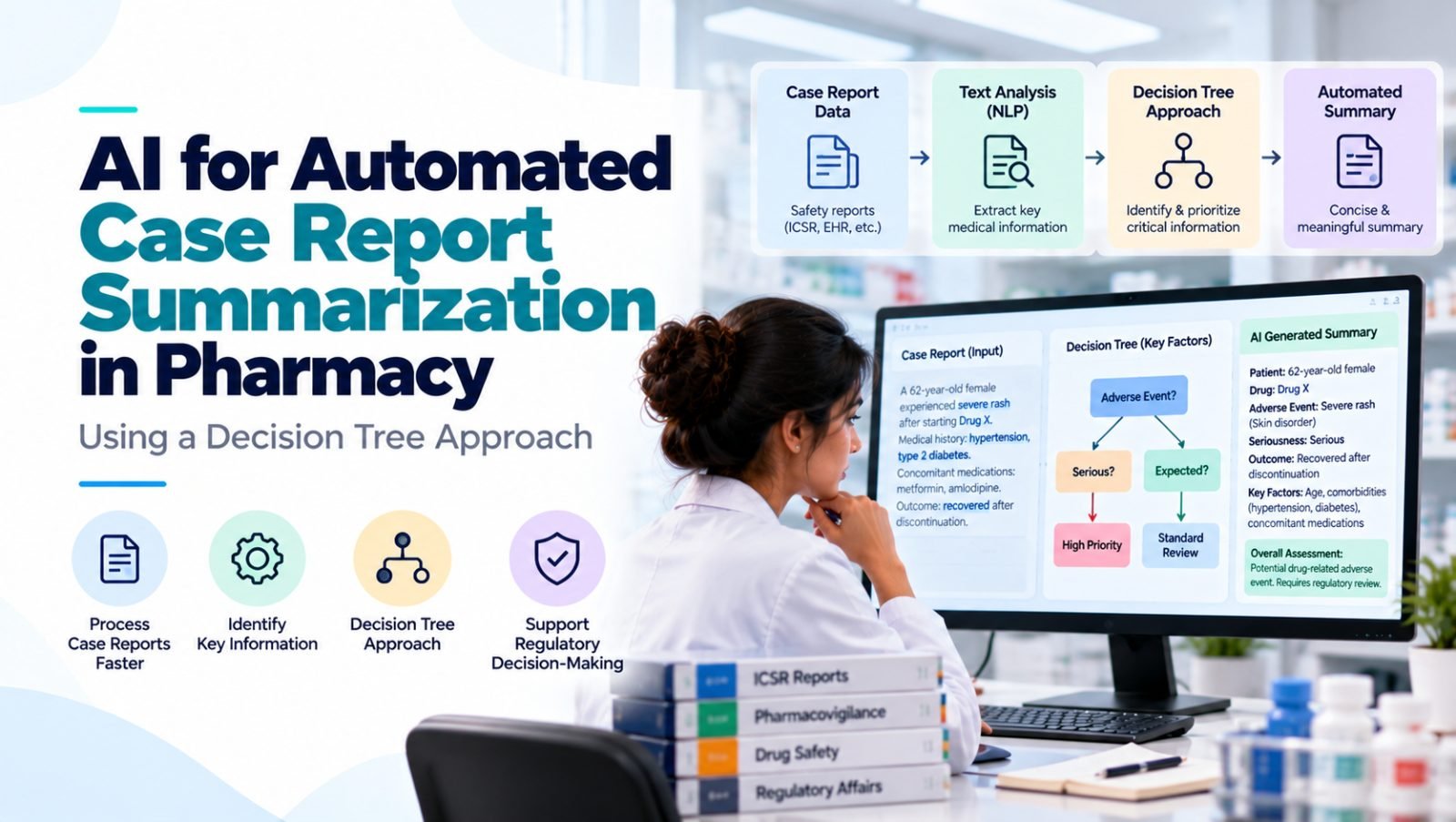
The key components of AI for automated case report summarization include:
- Data preprocessing: cleaning and formatting the case report data
- Text analysis: using NLP techniques to extract relevant information from the case reports
- Decision tree: using a decision tree approach to identify and prioritize the most critical information
- Summarization: generating a concise and meaningful summary of the case reports
For example, a pharmaceutical company may use a decision tree to identify the most critical information in case reports of adverse events, such as the severity of the event, the patient's medical history, and the treatment outcome.
How it works in practice — a concrete example
Let's consider a concrete example of how AI for automated case report summarization works in practice. Suppose a pharmaceutical company has a large dataset of case reports related to a new drug. The company wants to use AI to summarize these case reports and identify potential safety issues. The AI algorithm would first preprocess the data, cleaning and formatting the case reports. Then, it would use text analysis to extract relevant information from the case reports, such as the patient's age, sex, and medical history. Next, it would use a decision tree approach to identify and prioritize the most critical information, such as the severity of the adverse event and the treatment outcome. Finally, it would generate a concise and meaningful summary of the case reports, highlighting potential safety issues and trends.
Common challenges
One common challenge in AI for automated case report summarization is the quality of the input data. If the case reports are incomplete, inaccurate, or inconsistent, the AI algorithm may not be able to generate accurate summaries. Another challenge is the complexity of the decision tree approach, which requires careful tuning and validation to ensure that it is identifying the most critical information. For example, a pharmaceutical company may need to adjust the decision tree to account for different types of adverse events or patient populations.
Best practices
Best practices for AI for automated case report summarization include:
- Ensuring high-quality input data through data validation and cleaning
- Using a decision tree approach that is tailored to the specific use case and dataset
- Validating the AI algorithm through testing and evaluation
- Continuously monitoring and updating the AI algorithm to ensure that it remains accurate and effective
For instance, a regulatory affairs professional may use a data validation tool to ensure that the case report data is complete and accurate before using the AI algorithm to generate summaries.
Common misconceptions
One common misconception about AI for automated case report summarization is that it replaces human judgment. However, AI is meant to assist regulatory affairs professionals, not replace them. Another misconception is that AI can only be used for simple summarization tasks, when in fact it can be used for complex tasks such as identifying potential safety issues and trends. For example, a pharmaceutical company may use AI to identify patterns in case reports of adverse events, allowing them to develop more effective safety strategies.
FAQ — 5 questions readers commonly ask, with detailed answers
- Q: How does AI for automated case report summarization work? A: AI for automated case report summarization uses NLP techniques to extract relevant information from case reports and a decision tree approach to identify and prioritize the most critical information.
- Q: What are the benefits of using AI for automated case report summarization? A: The benefits of using AI for automated case report summarization include saving time and resources, improving accuracy, and enhancing decision-making.
- Q: Can AI for automated case report summarization replace human judgment? A: No, AI for automated case report summarization is meant to assist regulatory affairs professionals, not replace them. Human judgment is still necessary to validate and interpret the results.
- Q: How do I get started with AI for automated case report summarization? A: To get started with AI for automated case report summarization, you will need to assemble a team with expertise in NLP, machine learning, and regulatory affairs. You will also need to select a suitable AI algorithm and platform, and validate and test the system.
- Q: What are the potential risks and limitations of AI for automated case report summarization? A: The potential risks and limitations of AI for automated case report summarization include the quality of the input data, the complexity of the decision tree approach, and the need for continuous monitoring and updating.
Conclusion
In conclusion, AI for automated case report summarization is a powerful tool that can help regulatory affairs professionals in pharmacy save time and resources, improve accuracy, and enhance decision-making. By using a decision tree approach and NLP techniques, AI can identify and prioritize the most critical information in case reports, generating concise and meaningful summaries. While there are challenges and limitations to consider, the benefits of AI for automated case report summarization make it an exciting and promising area of research and development in the field of pharmacy.