
Introduction
Pharmaceutical formulation science is a critical aspect of drug development, involving the design and optimization of drug formulations to ensure their safety, efficacy, and stability. Feature engineering, a key aspect of machine learning and AI, is increasingly being applied to pharmaceutical formulation science to improve the efficiency and effectiveness of the drug development process. In this article, we will explore the role of feature engineering in pharmaceutical formulation science, its applications, and future outlook.
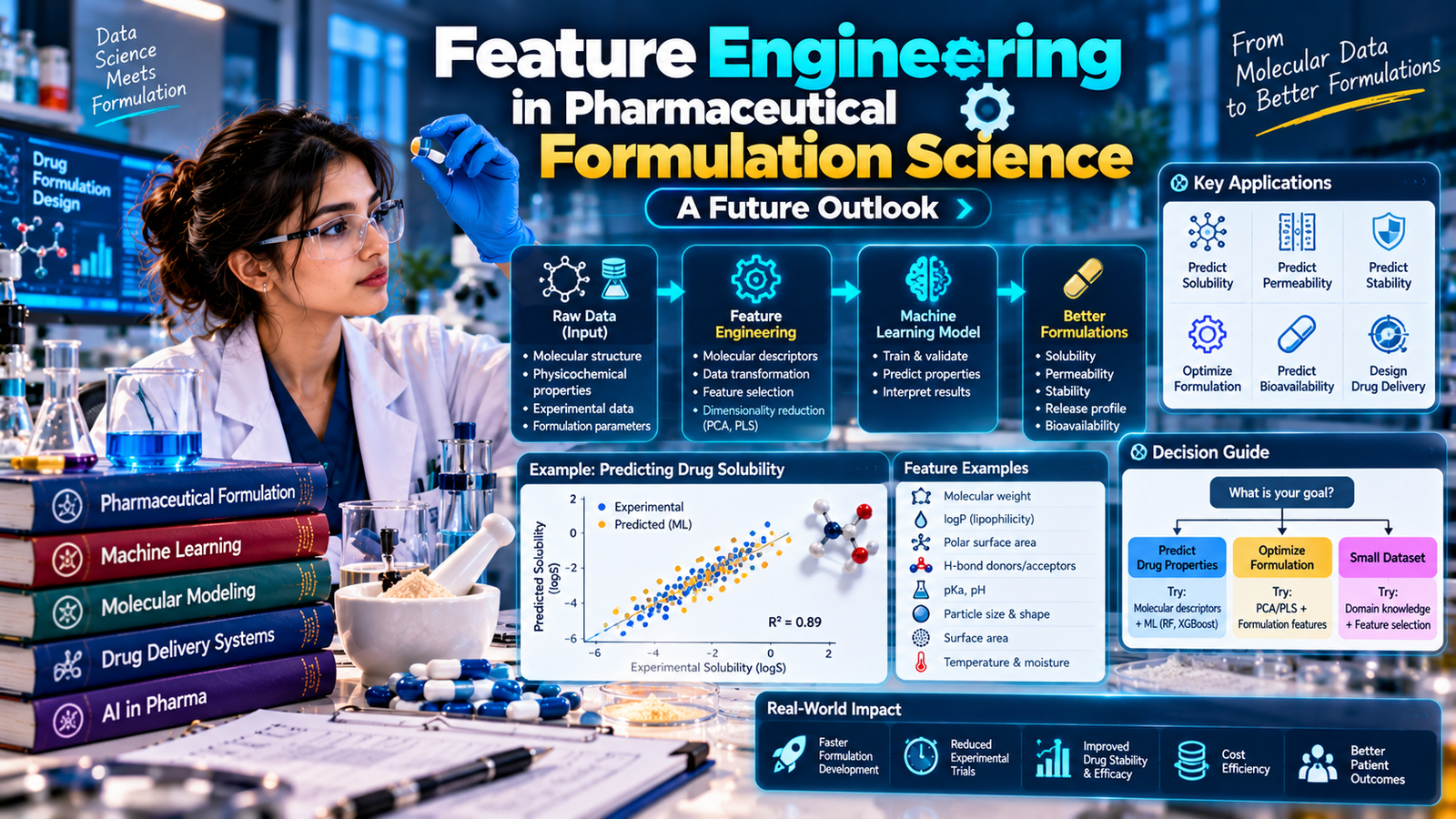
A concrete example of the application of feature engineering in pharmaceutical formulation science is the development of predictive models for drug solubility. By engineering features such as molecular descriptors and physicochemical properties, researchers can build models that accurately predict the solubility of drugs, facilitating the design of more effective formulations.
1. What is Feature Engineering?
Feature engineering is the process of selecting and transforming raw data into features that are more suitable for modeling and analysis. In pharmaceutical formulation science, feature engineering involves the extraction and transformation of relevant data from various sources, such as molecular structures, physicochemical properties, and experimental data.
For instance, feature engineering can be used to extract molecular descriptors such as molecular weight, logP, and polar surface area, which are critical in predicting drug permeability and bioavailability. By engineering these features, researchers can build more accurate models for predicting drug absorption and distribution.
2. Why is Feature Engineering Important in Pharmaceutical Formulation Science?
Feature engineering is essential in pharmaceutical formulation science because it enables the development of more accurate and reliable models for predicting drug behavior. By selecting and transforming the most relevant features, researchers can build models that capture the complex relationships between drug properties and their performance.
A specific example of the importance of feature engineering is the development of models for predicting drug stability. By engineering features such as pH, temperature, and moisture, researchers can build models that accurately predict the stability of drugs under various storage conditions, ensuring the development of more effective formulations.
3. Applications of Feature Engineering in Pharmaceutical Formulation Science
Feature engineering has numerous applications in pharmaceutical formulation science, including the development of predictive models for drug solubility, permeability, and bioavailability. Additionally, feature engineering can be used to optimize formulation parameters such as particle size, shape, and surface area.
For example, feature engineering can be used to develop models for predicting the effects of formulation parameters on drug release profiles. By engineering features such as particle size, shape, and surface area, researchers can build models that accurately predict the release profiles of drugs, facilitating the design of more effective formulations.
4. Techniques for Feature Engineering in Pharmaceutical Formulation Science
Several techniques are available for feature engineering in pharmaceutical formulation science, including molecular descriptor calculation, physicochemical property estimation, and data transformation. Additionally, machine learning algorithms such as principal component analysis (PCA) and partial least squares (PLS) can be used to select and transform features.
A concrete example of the application of feature engineering techniques is the use of PCA to reduce the dimensionality of molecular descriptor data. By applying PCA, researchers can extract the most relevant features and build more accurate models for predicting drug behavior.
5. Which One to Try First - A Decision Guide
When deciding which feature engineering technique to try first, researchers should consider the specific goals and objectives of their project. For instance, if the goal is to predict drug solubility, molecular descriptor calculation and physicochemical property estimation may be the most suitable techniques.
On the other hand, if the goal is to optimize formulation parameters, data transformation and machine learning algorithms such as PCA and PLS may be more appropriate. By carefully selecting the most relevant techniques and features, researchers can build more accurate models and develop more effective formulations.
Conclusion
In conclusion, feature engineering is a critical aspect of pharmaceutical formulation science, enabling the development of more efficient and effective drug formulations. By applying feature engineering techniques such as molecular descriptor calculation, physicochemical property estimation, and data transformation, researchers can build more accurate models for predicting drug behavior and optimize formulation parameters.
A concrete example of the benefits of feature engineering in pharmaceutical formulation science is the development of more effective formulations for poorly soluble drugs. By engineering features such as molecular descriptors and physicochemical properties, researchers can build models that accurately predict the solubility of drugs, facilitating the design of more effective formulations and improving patient outcomes.
Common Misconceptions about Feature Engineering in Pharmaceutical Formulation Science
One common misconception about feature engineering in pharmaceutical formulation science is that it is a straightforward process that can be automated without human intervention. However, feature engineering requires careful consideration of the specific goals and objectives of the project, as well as the selection and transformation of the most relevant features.
Another misconception is that feature engineering is only applicable to large datasets. However, feature engineering can be applied to small datasets as well, and can be used to extract valuable insights and build more accurate models.
Practical Examples of Feature Engineering in Pharmaceutical Formulation Science
A practical example of feature engineering in pharmaceutical formulation science is the development of predictive models for drug permeability. By engineering features such as molecular descriptors and physicochemical properties, researchers can build models that accurately predict the permeability of drugs, facilitating the design of more effective formulations.
Another example is the optimization of formulation parameters such as particle size, shape, and surface area. By engineering features such as particle size distribution and surface area, researchers can build models that accurately predict the effects of formulation parameters on drug release profiles, facilitating the design of more effective formulations.
FAQs about Feature Engineering in Pharmaceutical Formulation Science
Q: What is feature engineering, and how is it applied in pharmaceutical formulation science?
A: Feature engineering is the process of selecting and transforming raw data into features that are more suitable for modeling and analysis. In pharmaceutical formulation science, feature engineering involves the extraction and transformation of relevant data from various sources, such as molecular structures, physicochemical properties, and experimental data.
Q: What are the benefits of feature engineering in pharmaceutical formulation science?
A: The benefits of feature engineering in pharmaceutical formulation science include the development of more accurate and reliable models for predicting drug behavior, the optimization of formulation parameters, and the design of more effective formulations.