
Introduction
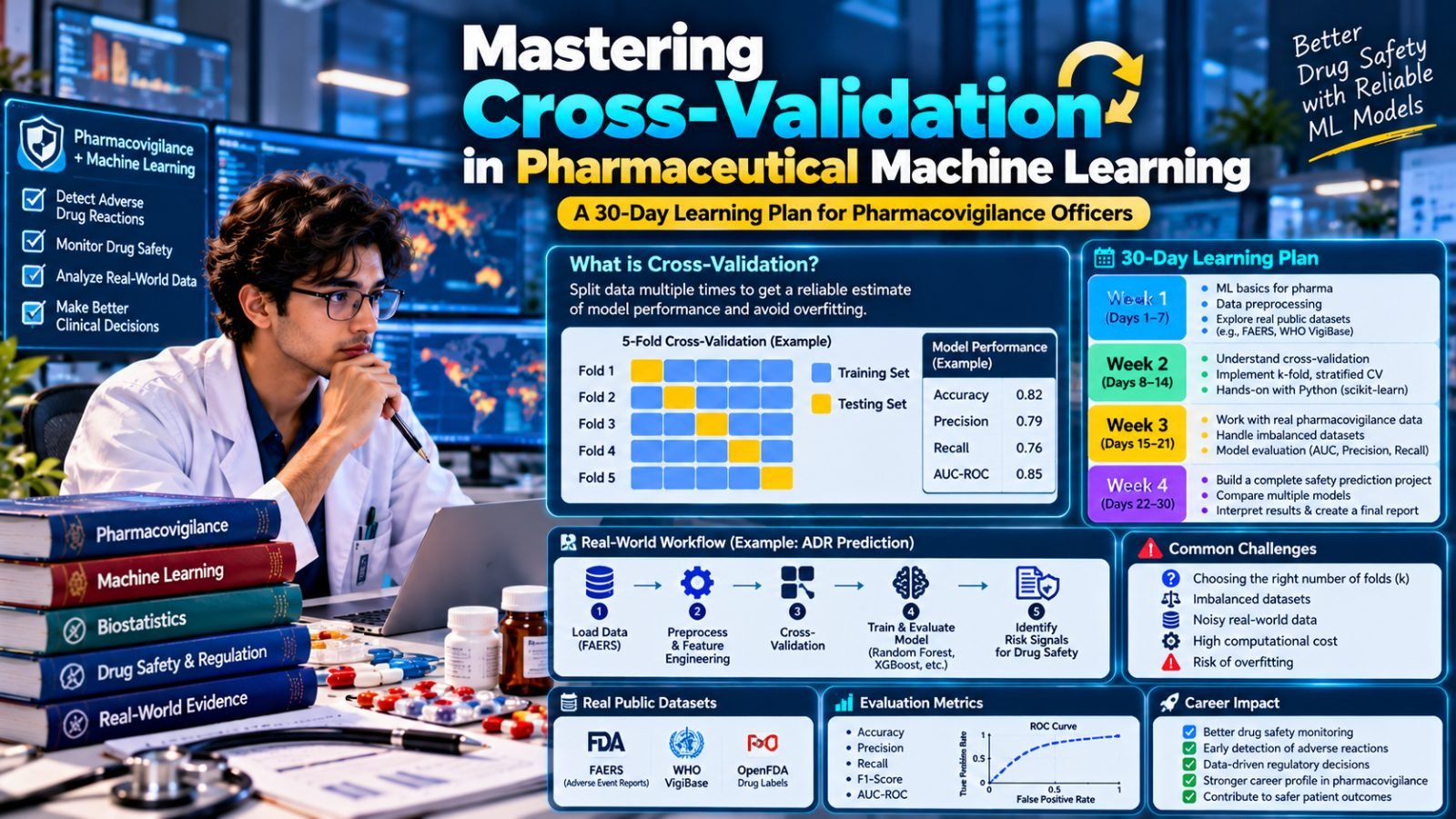
Machine learning is increasingly used in pharmaceutical research to improve drug development and patient outcomes. Cross-validation is a crucial technique in machine learning that helps evaluate model performance and prevent overfitting. In this article, we will explore the concept of cross-validation in pharmaceutical machine learning, its importance, and provide a 30-day learning plan for pharmacovigilance officers to master this technique using real public datasets.
What it is / what it isn't
Cross-validation is a statistical technique used to evaluate the performance of a machine learning model on unseen data. It involves splitting the available data into training and testing sets, training the model on the training set, and evaluating its performance on the testing set. This process is repeated multiple times, with different splits of the data, to obtain a reliable estimate of the model's performance. Cross-validation is not the same as bootstrapping, which involves resampling the data with replacement to estimate the variability of a statistic.
Why it matters for the target audience
Pharmacovigilance officers are responsible for monitoring the safety of drugs and detecting potential adverse reactions. Machine learning can help them identify patterns in large datasets and predict potential safety issues. Cross-validation is essential in this context, as it helps ensure that the models used for prediction are reliable and generalizable to new, unseen data. By mastering cross-validation, pharmacovigilance officers can improve the accuracy of their predictions and make more informed decisions.
Key components or steps
The key components of cross-validation include data splitting, model training, and model evaluation. The data is typically split into k folds, where k is a user-defined parameter. The model is then trained on k-1 folds and evaluated on the remaining fold. This process is repeated k times, with each fold used as the testing set once. The performance of the model is evaluated using metrics such as accuracy, precision, and recall.
How it works in practice — a concrete example
Suppose we have a dataset of 100 patients, each with a set of features such as age, sex, and medical history, and a label indicating whether they experienced an adverse reaction to a particular drug. We want to train a machine learning model to predict the likelihood of an adverse reaction based on these features. We split the data into 5 folds and use 4 folds to train the model and 1 fold to evaluate its performance. We repeat this process 5 times, with each fold used as the testing set once. The performance of the model is evaluated using the area under the receiver operating characteristic curve (AUC-ROC). By using cross-validation, we can obtain a reliable estimate of the model's performance and identify the most important features contributing to the prediction.
Common challenges
One common challenge in cross-validation is the choice of the number of folds (k). A small value of k can lead to biased estimates of the model's performance, while a large value of k can lead to high computational costs. Another challenge is the handling of imbalanced datasets, where one class has a significantly larger number of instances than the others. In such cases, techniques such as oversampling the minority class or undersampling the majority class can be used to balance the dataset.
Best practices
Best practices for cross-validation include using a suitable value of k, handling imbalanced datasets, and using techniques such as stratified sampling to ensure that the testing set is representative of the population. It is also essential to use a suitable evaluation metric, such as AUC-ROC, to assess the performance of the model. Additionally, cross-validation should be used in conjunction with other techniques, such as feature selection and hyperparameter tuning, to optimize the performance of the model.
Common misconceptions
One common misconception about cross-validation is that it is only used for model selection. While cross-validation can be used to compare the performance of different models, it is also essential for evaluating the performance of a single model. Another misconception is that cross-validation is only used for classification problems. Cross-validation can be used for regression problems as well, where the goal is to predict a continuous outcome variable.
FAQ — 5 questions readers commonly ask, with detailed answers
- Q: What is the difference between cross-validation and bootstrapping? A: Cross-validation involves splitting the data into training and testing sets, while bootstrapping involves resampling the data with replacement to estimate the variability of a statistic.
- Q: How do I choose the number of folds (k) in cross-validation? A: The choice of k depends on the size of the dataset and the computational costs. A common choice is k=5 or k=10.
- Q: Can I use cross-validation for regression problems? A: Yes, cross-validation can be used for regression problems, where the goal is to predict a continuous outcome variable.
- Q: How do I handle imbalanced datasets in cross-validation? A: Techniques such as oversampling the minority class or undersampling the majority class can be used to balance the dataset.
- Q: Can I use cross-validation for model selection? A: Yes, cross-validation can be used to compare the performance of different models and select the best one.
Conclusion
In conclusion, cross-validation is a crucial technique in machine learning that helps evaluate model performance and prevent overfitting. By mastering cross-validation, pharmacovigilance officers can improve the accuracy of their predictions and make more informed decisions. In this article, we provided a 30-day learning plan for pharmacovigilance officers to learn cross-validation using real public datasets. We also discussed the key components of cross-validation, common challenges, best practices, and common misconceptions. By following this learning plan and practicing cross-validation, pharmacovigilance officers can become proficient in this technique and improve their machine learning skills.