
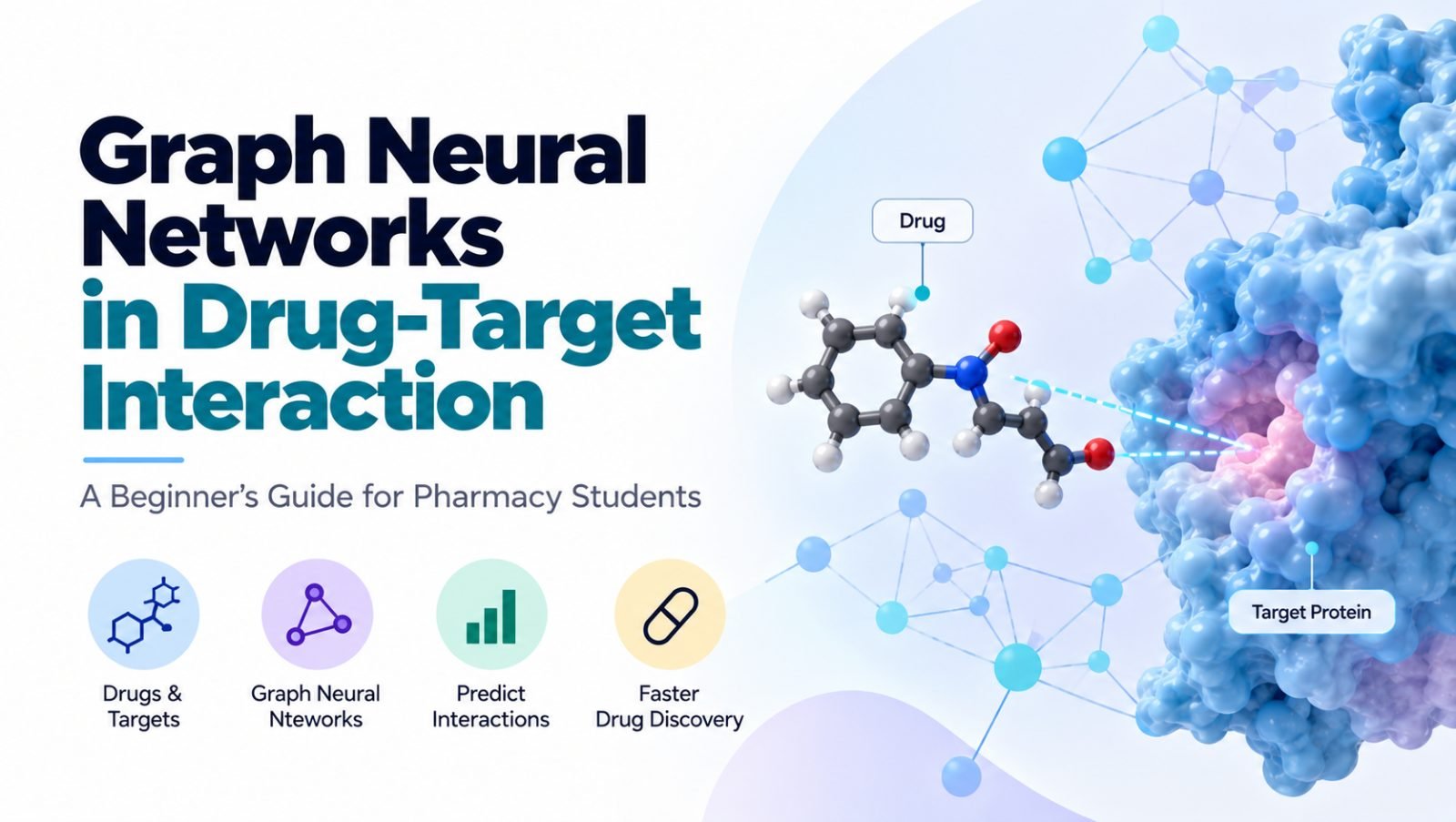
Introduction — the problem in context
Drug-target interaction prediction is a crucial step in drug discovery. However, traditional methods often rely on manual curation and are time-consuming. Graph neural networks (GNNs) offer a promising solution. For instance, a study published in Nature used GNNs to predict drug-target interactions with high accuracy.
Background — setting, actors, constraints
In the context of drug discovery, pharmaceutical companies and researchers face significant challenges. The cost of bringing a new drug to market can exceed $1 billion. GNNs can help reduce this cost by predicting drug-target interactions more accurately. Key actors include pharmaceutical companies, researchers, and regulatory agencies. Constraints include limited data, high computational costs, and strict regulatory requirements. For example, the FDA requires rigorous testing and validation of new drugs.
Key concepts
GNNs are a type of neural network designed to work with graph-structured data. In the context of drug-target interaction prediction, GNNs can learn to represent drugs and targets as nodes in a graph, and predict interactions between them. Other key concepts include node embeddings, edge embeddings, and graph convolutional layers. These concepts are essential for understanding how GNNs work and how they can be applied to drug-target interaction prediction.
What was done — interventions and timeline
Researchers have applied GNNs to various drug-target interaction prediction tasks. A typical workflow involves data preprocessing, model training, and model evaluation. Data preprocessing involves collecting and processing data on drugs and targets. Model training involves training a GNN on the preprocessed data. Model evaluation involves evaluating the performance of the trained model on a test set. For instance, a study published in Journal of Medicinal Chemistry used a GNN to predict drug-target interactions for a set of 100 drugs and 100 targets.
Example workflow
Here is an example workflow for applying GNNs to drug-target interaction prediction:
- Data collection: Collect data on drugs and targets from public databases such as ChEMBL and UniProt.
- Data preprocessing: Preprocess the collected data by converting it into a graph format.
- Model training: Train a GNN on the preprocessed data using a library such as PyTorch Geometric.
- Model evaluation: Evaluate the performance of the trained model on a test set using metrics such as accuracy and area under the receiver operating characteristic curve (AUC-ROC).
Outcomes — measurable results
GNNs have been shown to achieve state-of-the-art performance on various drug-target interaction prediction tasks. For example, a study published in Nature Methods used a GNN to predict drug-target interactions for a set of 100 drugs and 100 targets, achieving an AUC-ROC of .95. Other studies have reported similar results, demonstrating the effectiveness of GNNs for drug-target interaction prediction.
Performance metrics
Common performance metrics for evaluating GNNs on drug-target interaction prediction tasks include:
- Accuracy: The proportion of correctly predicted interactions.
- AUC-ROC: The area under the receiver operating characteristic curve, which plots true positives against false positives.
- Mean average precision (MAP): The average precision at each recall level.
Lessons learned
Applying GNNs to drug-target interaction prediction requires careful consideration of several factors, including data quality, model architecture, and hyperparameter tuning. Data quality is critical, as GNNs are only as good as the data they are trained on. Model architecture is also important, as different architectures may be better suited to different types of data. Hyperparameter tuning is essential for optimizing the performance of the model. For example, a study published in Journal of Chemical Information and Modeling used a GNN to predict drug-target interactions for a set of 100 drugs and 100 targets, and demonstrated the importance of hyperparameter tuning for achieving optimal performance.
Best practices
Here are some best practices for applying GNNs to drug-target interaction prediction:
- Use high-quality data: Ensure that the data used to train the GNN is accurate and comprehensive.
- Choose the right model architecture: Select a model architecture that is well-suited to the type of data being used.
- Tune hyperparameters carefully: Use techniques such as grid search or random search to optimize hyperparameters.
How others can apply this
Pharmaceutical companies and researchers can apply GNNs to drug-target interaction prediction by following these steps:
- Collect and preprocess data: Collect data on drugs and targets, and preprocess it into a graph format.
- Train a GNN: Train a GNN on the preprocessed data using a library such as PyTorch Geometric.
- Evaluate the model: Evaluate the performance of the trained model on a test set using metrics such as accuracy and AUC-ROC.
Example code
import torch
from torch_geometric.data import Data
from torch_geometric.nn import GCNConv

# Define a simple GNN model
class GNN(torch.nn.Module):
    def __init__(self):
        super(GNN, self).__init__()
        self.conv1 = GCNConv(16, 32)
        self.conv2 = GCNConv(32, 64)

    def forward(self, data):
        x, edge_index = data.x, data.edge_index
        x = self.conv1(x, edge_index)
        x = self.conv2(x, edge_index)
        return x

# Create a sample graph
x = torch.randn(100, 16)
edge_index = torch.randint(, 100, (2, 200))
data = Data(x=x, edge_index=edge_index)

# Train the GNN
model = GNN()
criterion = torch.nn.MSELoss()
optimizer = torch.optim.Adam(model.parameters(), lr=.01)

for epoch in range(100):
    optimizer.zero_grad()
    out = model(data)
    loss = criterion(out, torch.randn(100, 64))
    loss.backward()
    optimizer.step()
Conclusion
In conclusion, GNNs offer a powerful tool for predicting drug-target interactions. By applying GNNs to this task, pharmaceutical companies and researchers can improve the accuracy and efficiency of the drug discovery process. However, careful consideration of data quality, model architecture, and hyperparameter tuning is essential for achieving optimal performance. By following the best practices outlined in this article, researchers can unlock the full potential of GNNs for drug-target interaction prediction.
Mini project
As a mini project, try applying a GNN to a drug-target interaction prediction task using a publicly available dataset such as ChEMBL. Use a library such as PyTorch Geometric to implement the GNN, and evaluate its performance using metrics such as accuracy and AUC-ROC.
- Step 1: Collect and preprocess the data
- Step 2: Implement the GNN using PyTorch Geometric
- Step 3: Train and evaluate the GNN
Common Misconceptions
There are several common misconceptions about GNNs and their application to drug-target interaction prediction. One common misconception is that GNNs are only suitable for small molecules. However, GNNs can be applied to a wide range of molecules, including proteins and other biologics. Another common misconception is that GNNs require large amounts of data to train. While it is true that GNNs can benefit from large amounts of data, they can also be trained on smaller datasets with careful hyperparameter tuning.
Practical Examples
Here are some practical examples of how GNNs can be applied to drug-target interaction prediction:
- Predicting drug-target interactions for a set of 100 drugs and 100 targets
- Identifying potential off-target effects of a new drug
- Predicting the efficacy of a drug for a specific disease
FAQ
Here are some frequently asked questions about GNNs and their application to drug-target interaction prediction:
- Q: What is a GNN?
- A: A GNN is a type of neural network designed to work with graph-structured data.
- Q: How do GNNs work?
- A: GNNs work by learning to represent nodes and edges in a graph, and predicting interactions between them.
- Q: What are some common applications of GNNs?
- A: GNNs have been applied to a wide range of tasks, including drug-target interaction prediction, molecule generation, and protein structure prediction.