
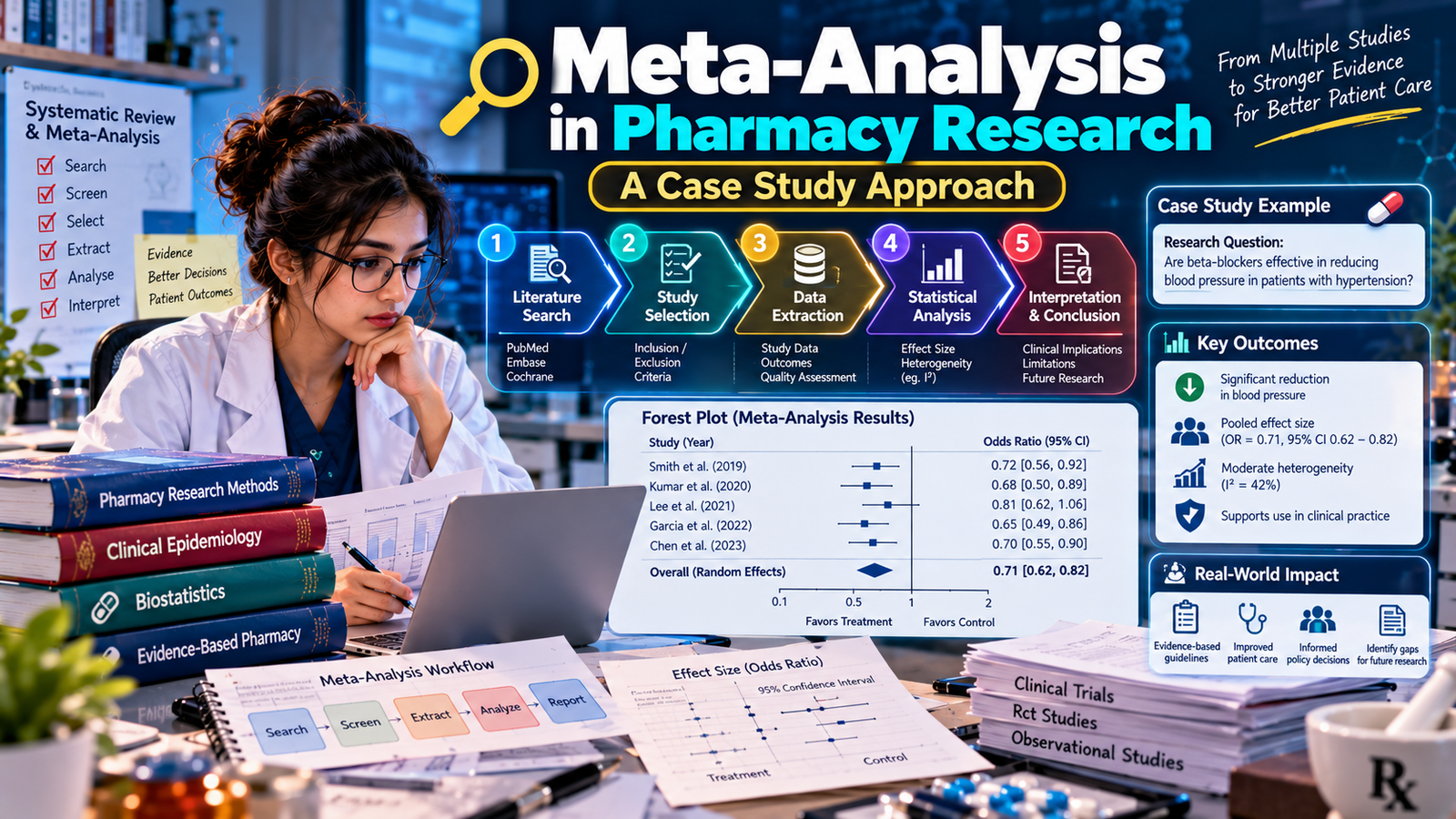
Introduction — the problem in context
Pharmacy research often involves analyzing data from multiple studies to draw conclusions about the effectiveness of treatments or interventions. However, combining data from different studies can be challenging due to variations in study design, population, and outcomes. Meta-analysis is a statistical technique that helps to address these challenges by providing a systematic and quantitative approach to synthesizing data from multiple studies.
For example, a pharmacist may want to investigate the effectiveness of a new medication for treating hypertension. A meta-analysis of multiple clinical trials can provide a more comprehensive understanding of the medication's efficacy and safety compared to a single study.
Background — setting, actors, constraints
In the context of pharmacy research, meta-analysis is often used to evaluate the effectiveness of medications, devices, or other interventions. The setting for meta-analysis can be a research institution, a pharmaceutical company, or a government agency. The actors involved in meta-analysis include researchers, statisticians, and clinicians who contribute to the design, conduct, and interpretation of the analysis.
Constraints in meta-analysis include the availability and quality of data, the heterogeneity of study designs and populations, and the potential for biases and confounding variables. For instance, a meta-analysis of studies on the effectiveness of a new medication may be limited by the availability of data on specific patient populations, such as pediatrics or geriatrics.
Key terms and definitions
Meta-analysis: a statistical technique for combining data from multiple studies to draw conclusions about a particular research question.
Heterogeneity: the variation in study designs, populations, and outcomes that can affect the validity and generalizability of meta-analysis results.
Confounding variables: factors that can influence the outcome of a study and may be unevenly distributed among study groups.
What was done — interventions and timeline
A typical meta-analysis involves several steps, including literature search, study selection, data extraction, and data analysis. The literature search involves identifying relevant studies through databases, such as PubMed or Embase, and applying inclusion and exclusion criteria to select studies that meet the research question.
For example, a researcher may conduct a literature search on the effectiveness of beta-blockers for treating hypertension and select studies that meet specific criteria, such as randomized controlled trials with a minimum sample size of 100 patients.
The timeline for meta-analysis can vary depending on the complexity of the research question, the availability of data, and the resources available. A typical meta-analysis may take several weeks to several months to complete.
Outcomes — measurable results
The outcomes of meta-analysis can include estimates of treatment effects, such as odds ratios or mean differences, and measures of variability, such as confidence intervals or standard deviations. For instance, a meta-analysis of studies on the effectiveness of beta-blockers for treating hypertension may report a pooled estimate of the odds ratio for reducing blood pressure.
Meta-analysis can also provide insights into the sources of heterogeneity and the potential for biases and confounding variables. For example, a meta-analysis may reveal that the effectiveness of beta-blockers varies by patient age or comorbidity status.
Lessons learned
Meta-analysis is a powerful tool for synthesizing data from multiple studies, but it requires careful attention to study design, data quality, and potential biases. Researchers should be aware of the limitations of meta-analysis, including the potential for publication bias and the importance of considering heterogeneity and confounding variables.
For example, a researcher may learn that a meta-analysis of studies on the effectiveness of a new medication is limited by the availability of data on specific patient populations and may require additional studies to fully understand the medication's efficacy and safety.
How others can apply this
Pharmacists and researchers can apply meta-analysis to a wide range of research questions, including the effectiveness of medications, devices, or other interventions. Meta-analysis can be used to inform clinical practice, guide policy decisions, and identify areas for further research.
For instance, a pharmacist may use meta-analysis to evaluate the effectiveness of different medications for treating a particular condition, such as diabetes or asthma, and develop evidence-based guidelines for clinical practice.
Conclusion
In conclusion, meta-analysis is a valuable tool for pharmacy research, providing a systematic and quantitative approach to synthesizing data from multiple studies. By understanding the principles and limitations of meta-analysis, pharmacists and researchers can apply this technique to a wide range of research questions and inform clinical practice, policy decisions, and future research.
A mini project on meta-analysis can help students and professionals develop practical skills in data analysis and interpretation. For example, a mini project may involve conducting a meta-analysis of studies on the effectiveness of a new medication and presenting the results in a clear and concise manner.
Mini project
Conduct a meta-analysis of studies on the effectiveness of a new medication for treating a particular condition, such as hypertension or diabetes. Use a database, such as PubMed or Embase, to identify relevant studies and apply inclusion and exclusion criteria to select studies that meet the research question.
Extract data from the selected studies and analyze the data using a statistical software package, such as R or STATA. Present the results in a clear and concise manner, including estimates of treatment effects and measures of variability.
Discuss the limitations of the meta-analysis, including the potential for publication bias and the importance of considering heterogeneity and confounding variables. Provide recommendations for future research and implications for clinical practice.
Practical implications
Meta-analysis has several practical implications for pharmacy research and clinical practice. It can help pharmacists and researchers evaluate the effectiveness of medications, devices, or other interventions and inform clinical practice, policy decisions, and future research.
For example, a meta-analysis of studies on the effectiveness of beta-blockers for treating hypertension may inform clinical guidelines for the treatment of hypertension and guide policy decisions on the use of beta-blockers in clinical practice.
Common misconceptions
There are several common misconceptions about meta-analysis, including the idea that it is a simple process of combining data from multiple studies. In reality, meta-analysis requires careful attention to study design, data quality, and potential biases.
Another misconception is that meta-analysis can provide definitive answers to research questions. In reality, meta-analysis is a tool for synthesizing data from multiple studies and should be interpreted in the context of the available evidence.
FAQ
Q: What is meta-analysis?
A: Meta-analysis is a statistical technique for combining data from multiple studies to draw conclusions about a particular research question.
Q: What are the limitations of meta-analysis?
A: The limitations of meta-analysis include the potential for publication bias, the importance of considering heterogeneity and confounding variables, and the need for careful attention to study design and data quality.