
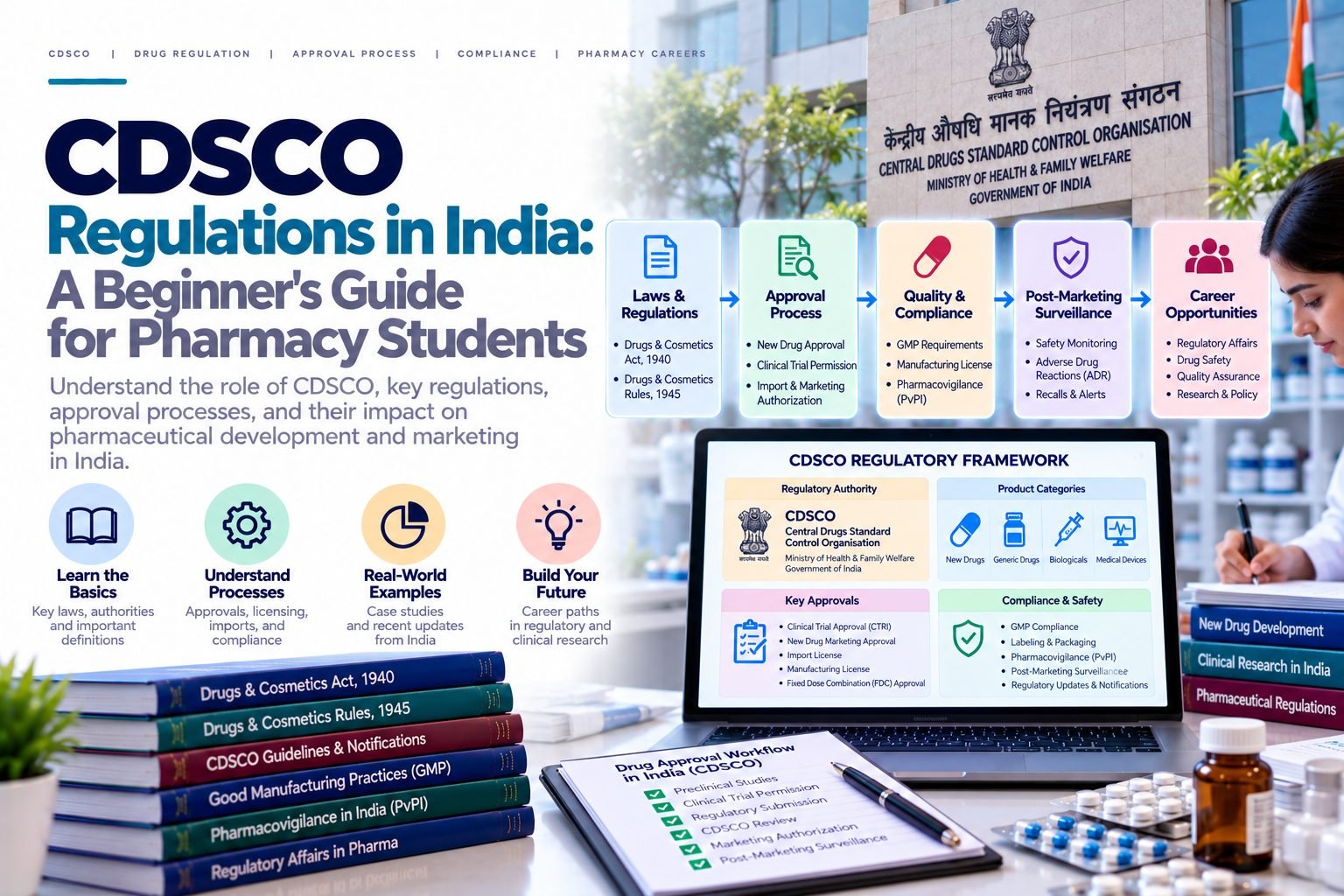
Introduction — what we're building and why
As pharmacy students in India, it's essential to understand the CDSCO (Central Drugs Standard Control Organization) regulations that govern the pharmaceutical industry. In this article, we'll explore the basics of CDSCO regulations and how to use real public datasets to enhance pharmacy education. We'll provide a step-by-step walkthrough, code examples, and practical tips for beginners.
For instance, let's consider a scenario where a pharmacy student wants to analyze the safety profile of a newly approved drug in India. By using CDSCO's public dataset on approved drugs, the student can extract relevant information and perform a statistical analysis to identify potential safety concerns.
Prerequisites
Before diving into CDSCO regulations, it's essential to have a basic understanding of pharmacy education and the Indian pharmaceutical industry. Familiarity with programming languages like Python and data analysis libraries like Pandas is also recommended. Additionally, students should have access to real public datasets, such as those provided by CDSCO or other government agencies.
For example, the CDSCO website provides a dataset on approved drugs, which includes information on drug names, manufacturers, and approval dates. By using this dataset, students can practice data analysis and visualization techniques to gain insights into the Indian pharmaceutical market.
Step-by-step walkthrough with code examples
Let's walk through an example of how to use CDSCO's public dataset to analyze the safety profile of a newly approved drug. First, we need to import the necessary libraries and load the dataset.
import pandas as pd
# Load CDSCO dataset on approved drugs
cdsco_data = pd.read_csv('cdsco_approved_drugs.csv')
Next, we can filter the dataset to extract information on the newly approved drug and perform a statistical analysis to identify potential safety concerns.
# Filter dataset for newly approved drug
new_drug_data = cdsco_data[cdsco_data['drug_name'] == 'New Drug']
# Perform statistical analysis to identify potential safety concerns
safety_concerns = new_drug_data['safety_profile'].value_counts()
By using real public datasets and programming languages like Python, pharmacy students can develop practical skills in data analysis and visualization, which are essential for a career in the pharmaceutical industry.
Common errors and how to fix them
When working with CDSCO regulations and public datasets, students may encounter common errors, such as data formatting issues or missing values. To fix these errors, students can use data cleaning and preprocessing techniques, such as handling missing values and data normalization.
For instance, let's consider a scenario where the CDSCO dataset contains missing values for certain drug approvals. To fix this issue, students can use the Pandas library to handle missing values and ensure that the dataset is complete and accurate.
# Handle missing values in CDSCO dataset
cdsco_data.fillna('Unknown', inplace=True)
By using data cleaning and preprocessing techniques, students can ensure that their analysis is accurate and reliable, which is essential for making informed decisions in the pharmaceutical industry.
Best practices for production use
When working with CDSCO regulations and public datasets in a production environment, it's essential to follow best practices, such as data validation, security, and compliance. Students should ensure that their analysis is accurate, reliable, and compliant with regulatory requirements.
For example, let's consider a scenario where a pharmacy company wants to use CDSCO's public dataset to develop a predictive model for drug safety. To ensure that the model is accurate and reliable, the company should follow best practices, such as data validation, model testing, and compliance with regulatory requirements.
# Validate CDSCO dataset for production use
cdsco_data.validate('cdsco_approved_drugs_schema.json')
By following best practices, students can ensure that their analysis is accurate, reliable, and compliant with regulatory requirements, which is essential for a career in the pharmaceutical industry.
Where to go next
After completing this beginner's guide to CDSCO regulations and public datasets, students can explore more advanced topics, such as data visualization, machine learning, and predictive modeling. Additionally, students can apply their skills to real-world scenarios, such as analyzing the safety profile of newly approved drugs or developing predictive models for drug efficacy.
For instance, let's consider a scenario where a pharmacy student wants to develop a predictive model for drug efficacy using CDSCO's public dataset. The student can use machine learning libraries like Scikit-learn to develop a model that predicts drug efficacy based on factors like drug chemistry and pharmacology.
# Develop predictive model for drug efficacy
from sklearn.ensemble import RandomForestClassifier
# Train model on CDSCO dataset
model = RandomForestClassifier()
model.fit(cdsco_data.drop('efficacy', axis=1), cdsco_data['efficacy'])
By applying their skills to real-world scenarios, students can develop practical experience and build a strong foundation for a career in the pharmaceutical industry.
Common Misconceptions
When working with CDSCO regulations and public datasets, students may have common misconceptions, such as thinking that data analysis is only for statisticians or that regulatory compliance is only for lawyers. However, data analysis and regulatory compliance are essential skills for pharmacy students, and can be applied to a wide range of scenarios, from drug safety to pharmacology.
For example, let's consider a scenario where a pharmacy student wants to analyze the pharmacology of a newly approved drug. The student can use data analysis techniques to extract information on the drug's mechanism of action, dosage, and side effects, and apply this knowledge to develop a predictive model for drug efficacy.
# Analyze pharmacology of newly approved drug
pharmacology_data = cdsco_data[cdsco_data['drug_name'] == 'New Drug']
# Extract information on mechanism of action, dosage, and side effects
mechanism_of_action = pharmacology_data['mechanism_of_action']
dosage = pharmacology_data['dosage']
side_effects = pharmacology_data['side_effects']
By understanding common misconceptions and applying data analysis and regulatory compliance skills, students can develop a strong foundation for a career in the pharmaceutical industry.
Practical Examples
Let's consider a few practical examples of how CDSCO regulations and public datasets can be applied to real-world scenarios. For instance, a pharmacy company can use CDSCO's public dataset to develop a predictive model for drug safety, or a regulatory agency can use the dataset to monitor compliance with regulatory requirements.
For example, let's consider a scenario where a pharmacy company wants to develop a predictive model for drug safety using CDSCO's public dataset. The company can use machine learning libraries like Scikit-learn to develop a model that predicts drug safety based on factors like drug chemistry and pharmacology.
# Develop predictive model for drug safety
from sklearn.ensemble import RandomForestClassifier
# Train model on CDSCO dataset
model = RandomForestClassifier()
model.fit(cdsco_data.drop('safety', axis=1), cdsco_data['safety'])
By applying CDSCO regulations and public datasets to real-world scenarios, students can develop practical experience and build a strong foundation for a career in the pharmaceutical industry.
FAQ
Here are a few frequently asked questions about CDSCO regulations and public datasets:
- What is CDSCO, and what does it regulate?
- How can I access CDSCO's public dataset?
- What are some common applications of CDSCO regulations and public datasets?
For instance, let's consider a scenario where a pharmacy student wants to know how to access CDSCO's public dataset. The student can visit the CDSCO website and follow the instructions for downloading the dataset.
# Access CDSCO public dataset
cdsco_data = pd.read_csv('cdsco_approved_drugs.csv')
By understanding the answers to these frequently asked questions, students can develop a strong foundation for working with CDSCO regulations and public datasets.