
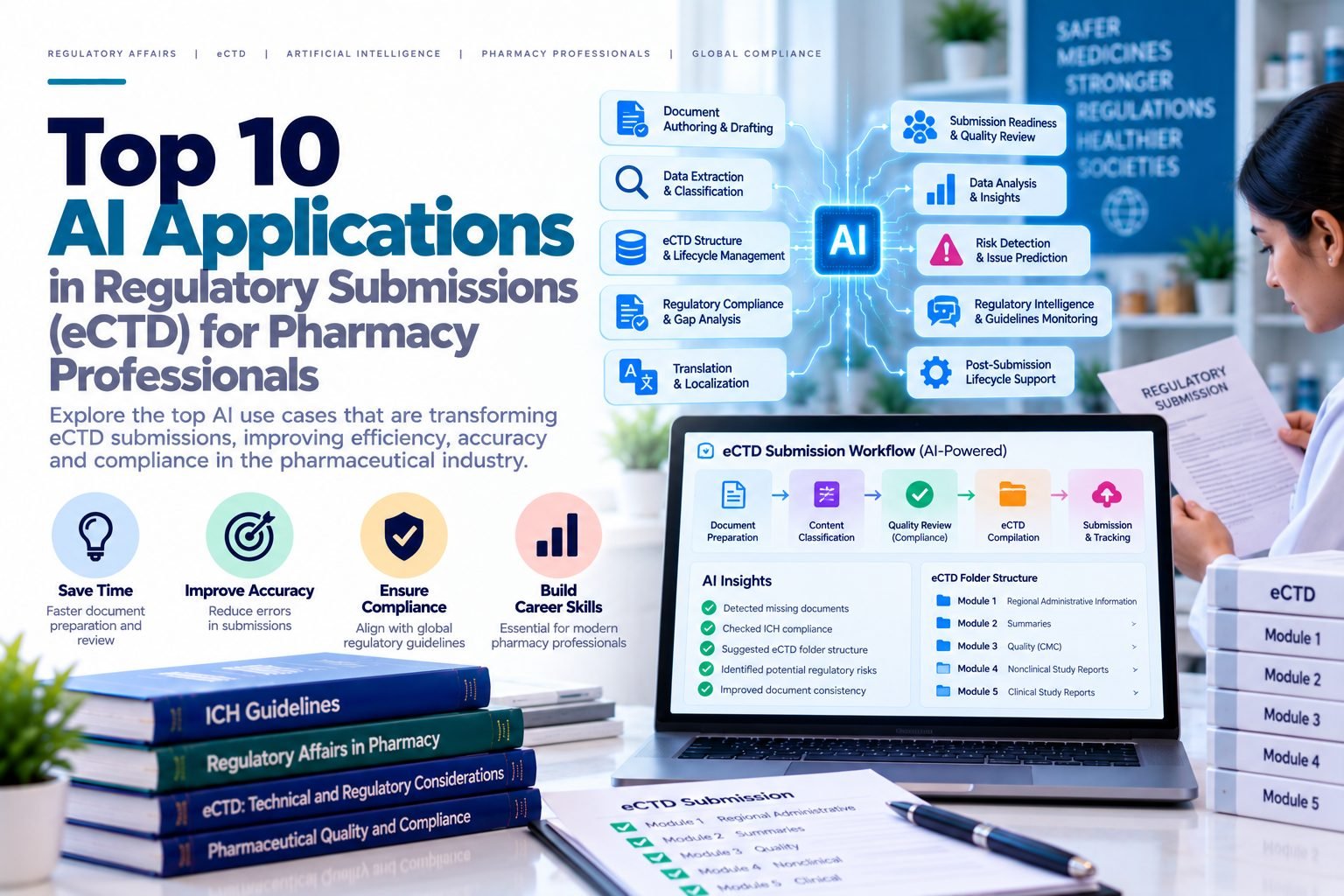
Hook — Frame the Question
As a regulatory affairs professional in the pharmaceutical industry, have you ever wondered how AI can simplify the regulatory submission process? With the increasing complexity of regulatory requirements, it's essential to explore innovative solutions that can reduce the burden on pharmaceutical companies. In this article, we'll delve into the top 10 AI applications in regulatory submissions (eCTD) that can benefit pharmacy professionals.
The Short Answer
AI can significantly improve the efficiency and accuracy of regulatory submissions by automating tasks, analyzing data, and providing insights. The top 10 AI applications in regulatory submissions (eCTD) include AI-powered document management, automated data validation, and predictive analytics.
The Long Answer
Introduction to AI in Regulatory Submissions
Regulatory submissions are a critical aspect of the pharmaceutical industry, requiring companies to submit detailed information about their products to regulatory authorities. The electronic Common Technical Document (eCTD) is a standardized format for submitting regulatory information. AI can play a significant role in streamlining the eCTD submission process by automating tasks, analyzing data, and providing insights.
For example, AI-powered document management systems can help pharmaceutical companies manage and track their regulatory documents, ensuring that all necessary information is included and up-to-date.
Top 10 AI Applications in Regulatory Submissions (eCTD)
The following are the top 10 AI applications in regulatory submissions (eCTD) that can benefit pharmacy professionals:
- AI-powered document management
- Automated data validation
- Predictive analytics
- Natural Language Processing (NLP) for regulatory text analysis
- Machine learning for regulatory submission forecasting
- AI-driven quality control
- Automated reporting and tracking
- AI-powered regulatory intelligence
- Machine learning for regulatory submission optimization
- AI-driven collaboration and communication tools
These AI applications can help pharmaceutical companies reduce the time and resources required for regulatory submissions, improving the overall efficiency and effectiveness of the process.
Benefits of AI in Regulatory Submissions
The benefits of AI in regulatory submissions include improved accuracy, reduced costs, and enhanced collaboration. AI can help pharmaceutical companies ensure that their regulatory submissions are complete and accurate, reducing the risk of errors and delays. Additionally, AI can help companies reduce their costs by automating tasks and streamlining processes.
For example, AI-powered automated reporting and tracking can help pharmaceutical companies monitor their regulatory submissions in real-time, reducing the need for manual tracking and follow-up.
Challenges and Limitations of AI in Regulatory Submissions
While AI has the potential to revolutionize the regulatory submission process, there are challenges and limitations to its adoption. One of the main challenges is the need for high-quality training data, which can be difficult to obtain in the pharmaceutical industry. Additionally, there may be regulatory and compliance issues to consider when implementing AI solutions.
For example, pharmaceutical companies must ensure that their AI systems comply with regulatory requirements, such as data protection and privacy laws.
Common Misconceptions
One common misconception about AI in regulatory submissions is that it will replace human regulatory professionals. However, AI is designed to augment and support human professionals, not replace them. AI can help automate routine tasks, freeing up human professionals to focus on higher-level tasks that require expertise and judgment.
Another misconception is that AI is only suitable for large pharmaceutical companies. However, AI solutions can be tailored to meet the needs of small and medium-sized companies, making them accessible to a wider range of organizations.
Practical Implications
The practical implications of AI in regulatory submissions are significant. Pharmaceutical companies that adopt AI solutions can expect to see improvements in efficiency, accuracy, and collaboration. Additionally, AI can help companies stay ahead of the competition by providing insights and predictions that can inform strategic decisions.
For example, AI-powered predictive analytics can help pharmaceutical companies forecast regulatory submission outcomes, allowing them to adjust their strategies accordingly.
FAQ
Here are some frequently asked questions about AI in regulatory submissions:
- What is the current state of AI adoption in regulatory submissions?
- How can AI improve the efficiency of regulatory submissions?
- What are the benefits of using AI in regulatory submissions?
- What are the challenges and limitations of AI in regulatory submissions?
- How can pharmaceutical companies ensure that their AI systems comply with regulatory requirements?
These questions and answers provide a starting point for exploring the potential of AI in regulatory submissions and understanding the practical implications of its adoption.
Conclusion
In conclusion, AI has the potential to transform the regulatory submission process in the pharmaceutical industry. By automating tasks, analyzing data, and providing insights, AI can help pharmaceutical companies improve the efficiency, accuracy, and effectiveness of their regulatory submissions. As the industry continues to evolve, it's essential for regulatory affairs professionals to stay up-to-date with the latest developments in AI and its applications in regulatory submissions.
By embracing AI and its potential, pharmaceutical companies can stay ahead of the competition and ensure that their products are brought to market quickly and safely. Whether you're a seasoned regulatory professional or just starting out, understanding the role of AI in regulatory submissions is crucial for success in the pharmaceutical industry.