
Introduction
Pharmacokinetics is the study of how the body absorbs, distributes, metabolizes, and eliminates drugs. Accurate calculations are crucial in pharmacokinetics to ensure safe and effective drug dosing. NumPy, a popular Python library, can be used to perform these calculations efficiently. In this article, we will explore how NumPy can be applied to pharmacokinetic calculations with a focus on model evaluation.
What it is / what it isn't
NumPy is a library for working with arrays and mathematical operations in Python. It is not a replacement for traditional pharmacokinetic software, but rather a tool to aid in calculations and data analysis. NumPy can be used to perform tasks such as data cleaning, statistical analysis, and visualization.
For example, consider a study where we need to calculate the area under the curve (AUC) of a drug's concentration-time profile. NumPy can be used to perform this calculation efficiently and accurately.
Why it matters for the target audience
Pharmacy students and professionals need to understand pharmacokinetic calculations to ensure safe and effective drug dosing. NumPy can aid in these calculations, making it an essential tool for pharmacy students and professionals. By using NumPy, pharmacists can quickly and accurately perform calculations, reducing the risk of errors and improving patient care.
For instance, consider a scenario where a pharmacist needs to calculate the dose of a drug for a patient with renal impairment. NumPy can be used to perform this calculation, taking into account the patient's renal function and other factors.
Key components or steps
The key components of using NumPy for pharmacokinetic calculations include data cleaning, statistical analysis, and visualization. The steps involved in using NumPy for pharmacokinetic calculations include:
- Data cleaning: removing missing or duplicate values, handling outliers
- Statistical analysis: calculating means, standard deviations, and other statistical parameters
- Visualization: plotting data to visualize trends and patterns
For example, consider a study where we need to calculate the pharmacokinetic parameters of a drug. NumPy can be used to perform these calculations, including data cleaning, statistical analysis, and visualization.
How it works in practice — a concrete example
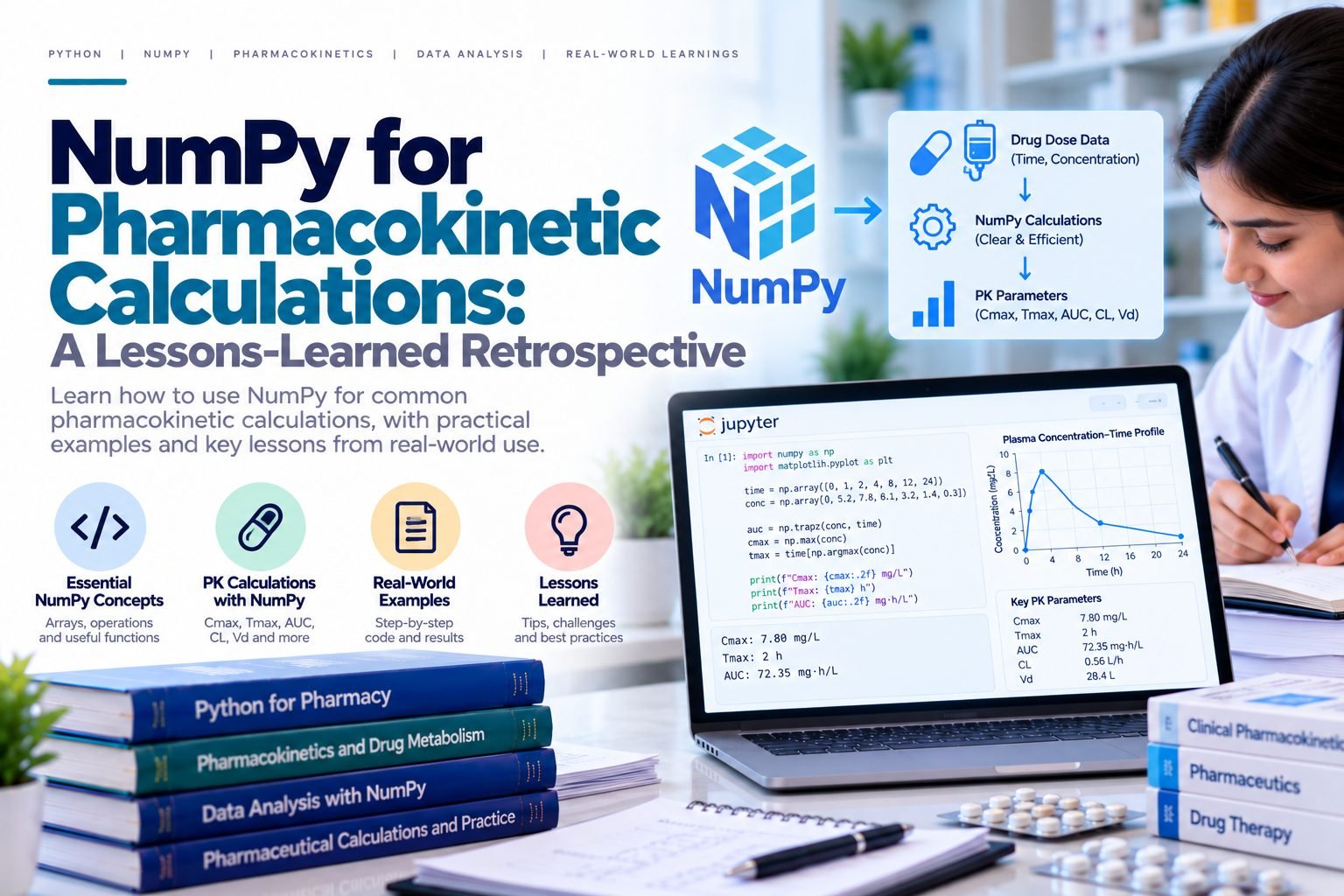
Consider a study where we need to calculate the AUC of a drug's concentration-time profile. We can use NumPy to perform this calculation efficiently and accurately. First, we import the necessary libraries and load the data.
import numpy as np
data = np.loadtxt('concentration_time_data.txt')
Next, we calculate the AUC using the trapezoidal rule.
auc = np.trapz(data[:, 1], data[:, ])Finally, we visualize the data to ensure that the calculation is accurate.
import matplotlib.pyplot as plt
plt.plot(data[:, ], data[:, 1])
plt.xlabel('Time (h)')
plt.ylabel('Concentration (mg/L)')
plt.show()
Common challenges
Common challenges when using NumPy for pharmacokinetic calculations include data quality issues, such as missing or duplicate values, and handling outliers. Additionally, pharmacists may need to deal with complex pharmacokinetic models, which can be difficult to implement in NumPy.
For example, consider a scenario where we need to calculate the pharmacokinetic parameters of a drug using a complex model. We can use NumPy to implement this model, but we need to be careful to handle any data quality issues and ensure that the model is implemented correctly.
Best practices
Best practices when using NumPy for pharmacokinetic calculations include:
- Ensuring data quality: checking for missing or duplicate values, handling outliers
- Validating calculations: checking that calculations are accurate and reliable
- Visualizing data: plotting data to visualize trends and patterns
For instance, consider a study where we need to calculate the pharmacokinetic parameters of a drug. We can use NumPy to perform these calculations, but we need to ensure that the data is of high quality and that the calculations are validated.
Common misconceptions
Common misconceptions when using NumPy for pharmacokinetic calculations include the idea that NumPy can replace traditional pharmacokinetic software. While NumPy can be used to perform calculations efficiently and accurately, it is not a replacement for traditional software.
For example, consider a scenario where a pharmacist needs to calculate the dose of a drug for a patient. While NumPy can be used to perform this calculation, it is not a replacement for traditional pharmacokinetic software, which can provide more comprehensive and accurate calculations.
FAQ — 5 questions readers commonly ask, with detailed answers
Q: What is NumPy and how can it be used in pharmacokinetics?
A: NumPy is a library for working with arrays and mathematical operations in Python. It can be used to perform pharmacokinetic calculations, such as data cleaning, statistical analysis, and visualization.
Q: How do I handle data quality issues when using NumPy for pharmacokinetic calculations?
A: To handle data quality issues, you can check for missing or duplicate values, handle outliers, and ensure that the data is of high quality.
Q: Can NumPy replace traditional pharmacokinetic software?
A: No, NumPy is not a replacement for traditional pharmacokinetic software. While it can be used to perform calculations efficiently and accurately, it is not a comprehensive software package.
Q: How do I validate calculations when using NumPy for pharmacokinetic calculations?
A: To validate calculations, you can check that the calculations are accurate and reliable, and visualize the data to ensure that the calculations are correct.
Q: What are the benefits of using NumPy for pharmacokinetic calculations?
A: The benefits of using NumPy for pharmacokinetic calculations include efficient and accurate calculations, improved data analysis, and visualization.
Conclusion
In conclusion, NumPy can be a valuable tool for pharmacokinetic calculations, providing efficient and accurate calculations, improved data analysis, and visualization. By understanding how to use NumPy for pharmacokinetic calculations, pharmacy students and professionals can improve patient care and ensure safe and effective drug dosing.