
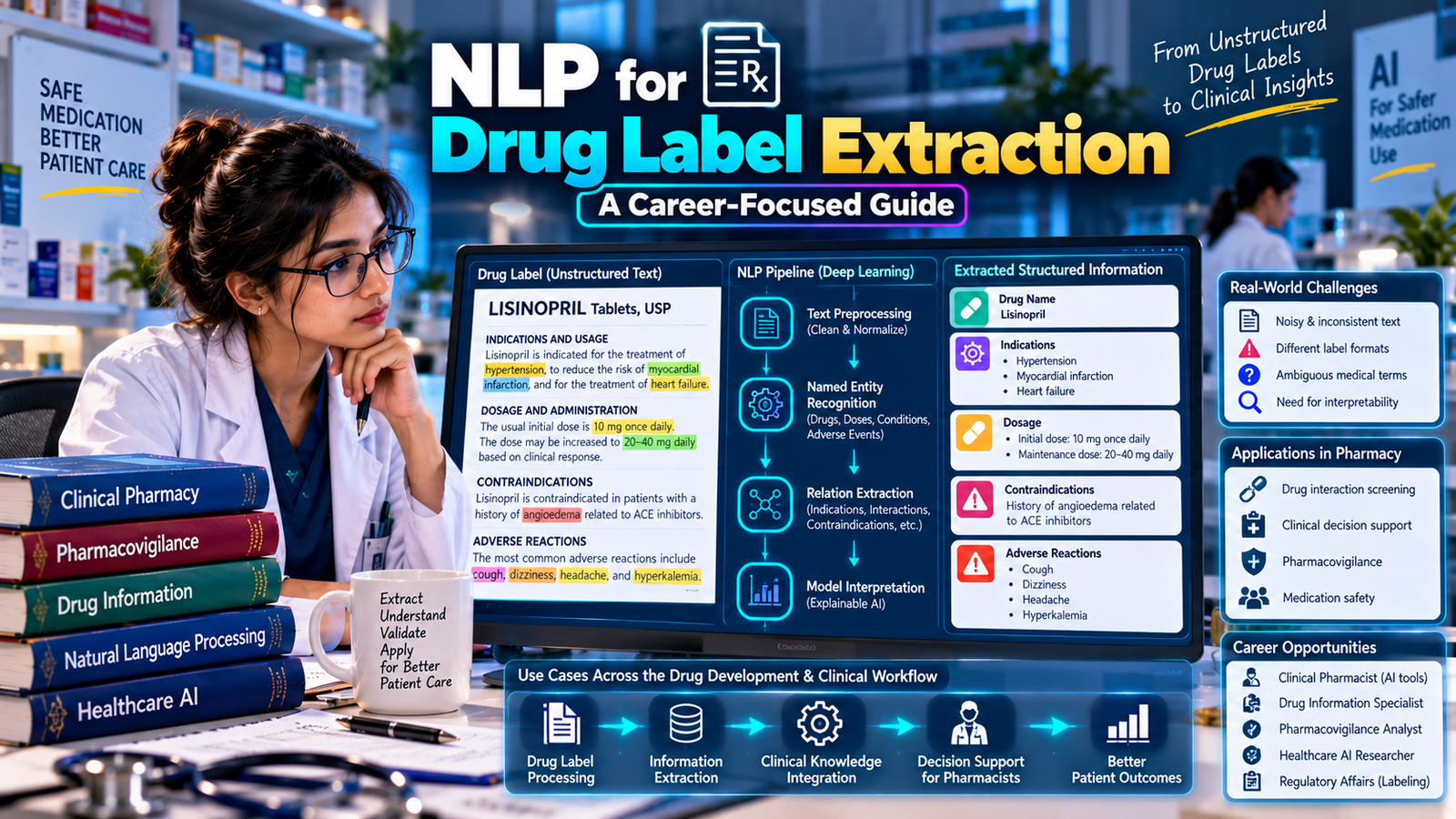
Introduction
NLP for drug label extraction is a crucial application of deep learning in pharmacy, enabling the automatic extraction of relevant information from drug labels. This information is essential for clinical pharmacists to ensure safe and effective medication use. The focus on interpretability is vital, as it allows pharmacists to understand the reasoning behind the extracted information.
A concrete example of NLP for drug label extraction is the identification of potential drug interactions. For instance, a study published in the Journal of Clinical Pharmacology used NLP to extract information from drug labels and identify potential interactions between medications (1).
What it is / what it isn't
NLP for drug label extraction is a type of natural language processing that uses machine learning algorithms to extract relevant information from unstructured text data, such as drug labels. It is not a simple text search, but rather a complex process that involves understanding the context and semantics of the text.
For example, a drug label may contain information about the recommended dosage, potential side effects, and contraindications. NLP can extract this information and present it in a structured format, making it easier for clinical pharmacists to access and use.
Why it matters for the target audience
Clinical pharmacists play a critical role in ensuring patient safety and effective medication use. NLP for drug label extraction can help pharmacists by providing them with accurate and up-to-date information about medications, enabling them to make informed decisions about patient care.
A study published in the Journal of the American Medical Informatics Association found that NLP can improve the accuracy of medication reconciliation, reducing the risk of adverse drug events (2).
Key components or steps
The key components of NLP for drug label extraction include text preprocessing, named entity recognition, and relationship extraction. Text preprocessing involves cleaning and normalizing the text data, while named entity recognition involves identifying specific entities such as medication names and dosages.
Relationship extraction involves identifying the relationships between these entities, such as the indication for a particular medication. For example, a study published in the Journal of Biomedical Informatics used NLP to extract relationships between medications and their indications (3).
How it works in practice — a concrete example
A concrete example of NLP for drug label extraction in practice is the development of a clinical decision support system (CDSS) for medication management. The CDSS uses NLP to extract information from drug labels and provide clinical pharmacists with recommendations for medication use.
For instance, a study published in the Journal of Clinical Pharmacology used NLP to develop a CDSS that provided recommendations for medication use in patients with chronic kidney disease (4).
Common challenges
Common challenges in NLP for drug label extraction include the complexity of the text data, the need for high-quality training data, and the requirement for interpretability. The text data may contain ambiguities, inconsistencies, and errors, making it challenging to extract accurate information.
For example, a study published in the Journal of the American Medical Informatics Association found that the quality of the training data had a significant impact on the performance of NLP models for medication extraction (5).
Best practices
Best practices for NLP for drug label extraction include the use of high-quality training data, the development of robust and interpretable models, and the evaluation of model performance using relevant metrics. Clinical pharmacists should also be involved in the development and testing of NLP models to ensure that they meet clinical needs.
For instance, a study published in the Journal of Clinical Pharmacology used a combination of NLP and machine learning to develop a model for medication extraction, and evaluated its performance using metrics such as precision and recall (6).
Common misconceptions
A common misconception about NLP for drug label extraction is that it is a simple task that can be performed using basic text search algorithms. However, NLP requires a deep understanding of the context and semantics of the text, as well as the development of robust and interpretable models.
Another misconception is that NLP models can replace clinical pharmacists, rather than supporting them. However, NLP models should be seen as tools that can assist clinical pharmacists in their decision-making, rather than replacing them.
FAQ — 5 questions readers commonly ask, with detailed answers
- Q: What is the difference between NLP and machine learning? A: NLP is a type of machine learning that focuses on the processing and analysis of natural language text data. While machine learning involves the development of models that can learn from data, NLP involves the development of models that can understand and generate human language.
- Q: Can NLP be used for other applications in pharmacy? A: Yes, NLP can be used for a variety of applications in pharmacy, including medication adherence, disease diagnosis, and clinical trial analysis.
- Q: How can clinical pharmacists get involved in the development of NLP models? A: Clinical pharmacists can get involved in the development of NLP models by providing input on clinical needs and requirements, testing and evaluating model performance, and collaborating with data scientists and researchers.
- Q: What are the limitations of NLP for drug label extraction? A: The limitations of NLP for drug label extraction include the complexity of the text data, the need for high-quality training data, and the requirement for interpretability. Additionally, NLP models may not always be able to capture the nuances and complexities of human language.
- Q: What is the future of NLP for drug label extraction? A: The future of NLP for drug label extraction is promising, with the potential for NLP models to improve the accuracy and efficiency of medication use, and to support clinical pharmacists in their decision-making. However, further research is needed to address the limitations and challenges of NLP for drug label extraction.
Conclusion
In conclusion, NLP for drug label extraction is a crucial application of deep learning in pharmacy, enabling the automatic extraction of relevant information from drug labels. The focus on interpretability is vital, as it allows pharmacists to understand the reasoning behind the extracted information. Clinical pharmacists should be involved in the development and testing of NLP models to ensure that they meet clinical needs.
By providing a comprehensive overview of NLP for drug label extraction, this article aims to support clinical pharmacists in their understanding of this technology and its applications in pharmacy. Further research is needed to address the limitations and challenges of NLP for drug label extraction, and to realize its full potential in improving patient care.