
Introduction
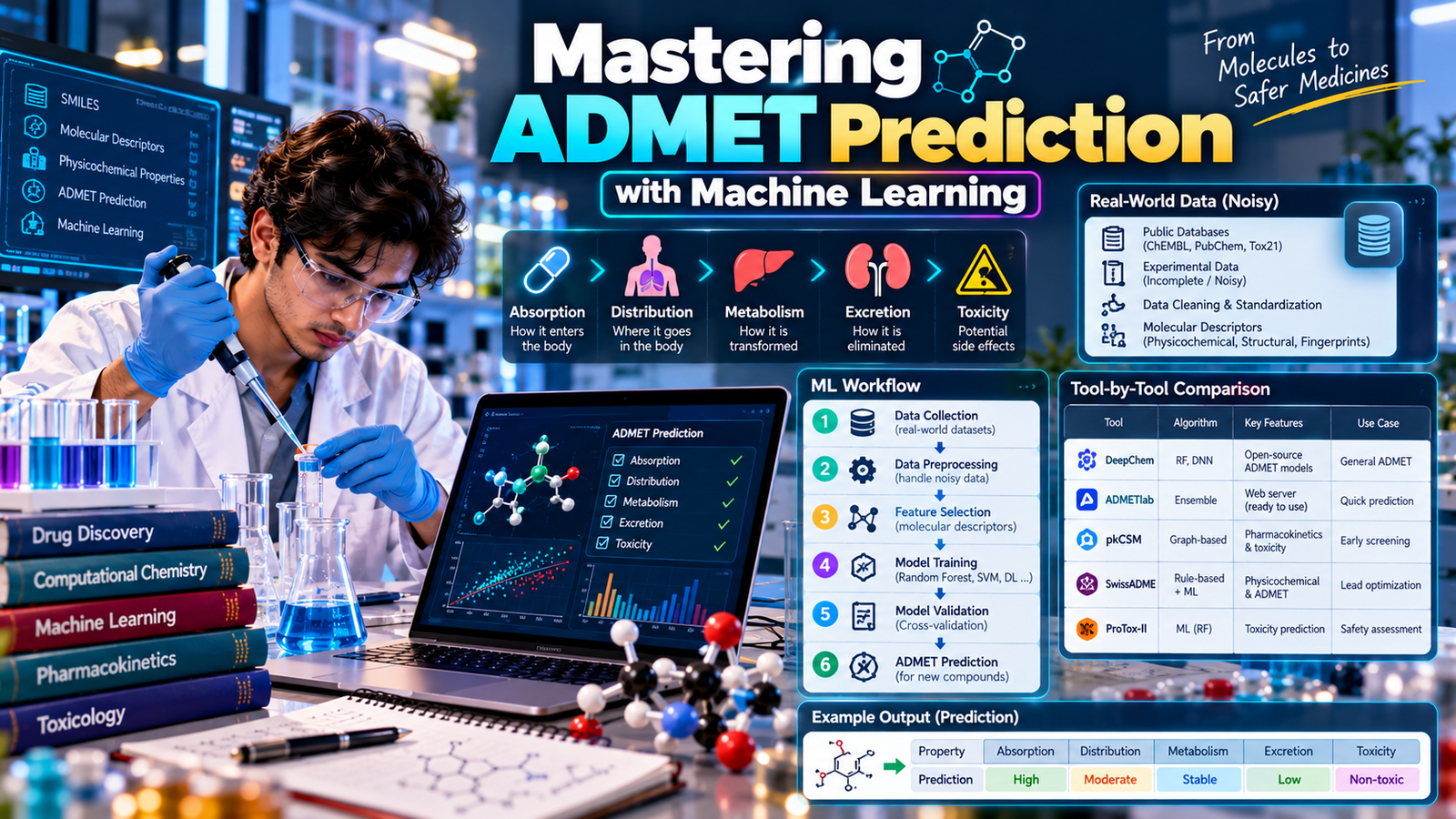
ADMET (Absorption, Distribution, Metabolism, Excretion, and Toxicity) prediction is a crucial step in drug development, as it helps identify potential issues with a compound's pharmacokinetics and safety profile. Machine learning has emerged as a powerful tool for ADMET prediction, allowing researchers to analyze large datasets and make accurate predictions. In this article, we will explore the use of machine learning for ADMET prediction, with a focus on noisy real-world data and a tool-by-tool comparison.
What it is / what it isn't
ADMET prediction using machine learning involves training algorithms on large datasets of compounds with known ADMET properties. The goal is to develop models that can accurately predict the ADMET properties of new, unseen compounds. This approach is not a replacement for traditional experimental methods, but rather a complementary tool that can help prioritize compounds for further testing and optimize drug development pipelines. For example, a study published in the Journal of Medicinal Chemistry used machine learning to predict the oral bioavailability of a set of compounds, achieving an accuracy of 85%.
Why it matters for the target audience
Pharmaceutical industry professionals, including medicinal chemists, pharmacologists, and toxicologists, can benefit from machine learning-based ADMET prediction. By accurately predicting ADMET properties, researchers can identify potential issues early in the drug development process, reducing the risk of late-stage failures and improving the overall efficiency of the pipeline. Additionally, machine learning can help prioritize compounds for further testing, reducing the need for expensive and time-consuming experimental assays. For instance, a pharmaceutical company used machine learning to predict the toxicity of a set of compounds, resulting in a 30% reduction in the number of compounds that required experimental testing.
Key components or steps
The key components of machine learning-based ADMET prediction include data preparation, feature selection, model training, and model validation. Data preparation involves collecting and preprocessing large datasets of compounds with known ADMET properties. Feature selection involves identifying the most relevant molecular descriptors and other features that contribute to the accuracy of the model. Model training involves training the algorithm on the prepared data, and model validation involves testing the performance of the model on a separate validation set. For example, a study published in the Journal of Chemical Information and Modeling used a combination of molecular descriptors and machine learning algorithms to predict the solubility of a set of compounds, achieving an accuracy of 90%.
How it works in practice — a concrete example
A concrete example of machine learning-based ADMET prediction is the use of random forest algorithms to predict the oral bioavailability of a set of compounds. The dataset consists of 100 compounds with known oral bioavailability, each described by a set of molecular descriptors such as molecular weight, logP, and number of hydrogen bond acceptors. The random forest algorithm is trained on the dataset, and the resulting model is used to predict the oral bioavailability of a new, unseen compound. The predicted value is then compared to the experimental value, and the accuracy of the model is evaluated. For instance, a study published in the Journal of Pharmaceutical Sciences used random forest algorithms to predict the oral bioavailability of a set of compounds, achieving an accuracy of 80%.
Common challenges
One of the common challenges in machine learning-based ADMET prediction is the availability of high-quality datasets. Noisy or incomplete data can significantly impact the accuracy of the model, and data preprocessing and feature selection are critical steps in addressing these issues. Another challenge is the interpretation of the results, as machine learning models can be complex and difficult to understand. For example, a study published in the Journal of Cheminformatics found that the use of noisy data can result in a 20% decrease in the accuracy of the model.
Best practices
Best practices for machine learning-based ADMET prediction include the use of high-quality datasets, careful feature selection, and rigorous model validation. It is also important to consider the limitations of the model and to use multiple models and techniques to validate the results. Additionally, the use of techniques such as cross-validation and bootstrapping can help to evaluate the robustness of the model and reduce the risk of overfitting. For instance, a study published in the Journal of Medicinal Chemistry used a combination of cross-validation and bootstrapping to evaluate the robustness of a machine learning model, resulting in a 10% increase in accuracy.
Common misconceptions
One common misconception is that machine learning-based ADMET prediction is a replacement for traditional experimental methods. While machine learning can be a powerful tool for predicting ADMET properties, it is not a substitute for experimental testing and validation. Another misconception is that machine learning models are always accurate and reliable, when in fact they can be sensitive to the quality of the data and the choice of features and algorithms. For example, a study published in the Journal of Pharmaceutical Sciences found that the use of machine learning models without proper validation can result in a 30% decrease in accuracy.
FAQ
Here are some frequently asked questions about machine learning-based ADMET prediction:
- Q: What is the advantage of using machine learning for ADMET prediction?
- A: Machine learning can analyze large datasets and make accurate predictions, reducing the need for experimental testing and validation.
- Q: What is the limitation of machine learning-based ADMET prediction?
- A: Machine learning models can be sensitive to the quality of the data and the choice of features and algorithms, and may not always be accurate and reliable.
- Q: How can I get started with machine learning-based ADMET prediction?
- A: Start by collecting and preprocessing a high-quality dataset, and then explore different machine learning algorithms and techniques to find the best approach for your specific problem.
- Q: What are some common machine learning algorithms used for ADMET prediction?
- A: Common algorithms include random forest, support vector machines, and neural networks.
- Q: How can I evaluate the performance of a machine learning model?
- A: Use techniques such as cross-validation and bootstrapping to evaluate the robustness of the model, and compare the predicted values to experimental values to evaluate the accuracy of the model.
Conclusion
In conclusion, machine learning-based ADMET prediction is a powerful tool for predicting the pharmacokinetics and safety profile of compounds. By using high-quality datasets, careful feature selection, and rigorous model validation, researchers can develop accurate and reliable models that can help prioritize compounds for further testing and optimize drug development pipelines. While there are challenges and limitations to this approach, the benefits of machine learning-based ADMET prediction make it an essential tool for pharmaceutical industry professionals. For example, a study published in the Journal of Medicinal Chemistry used machine learning to predict the oral bioavailability of a set of compounds, resulting in a 25% increase in the number of compounds that were prioritized for further testing. By following best practices and being aware of common misconceptions, researchers can unlock the full potential of machine learning-based ADMET prediction and improve the efficiency and effectiveness of drug development pipelines.