
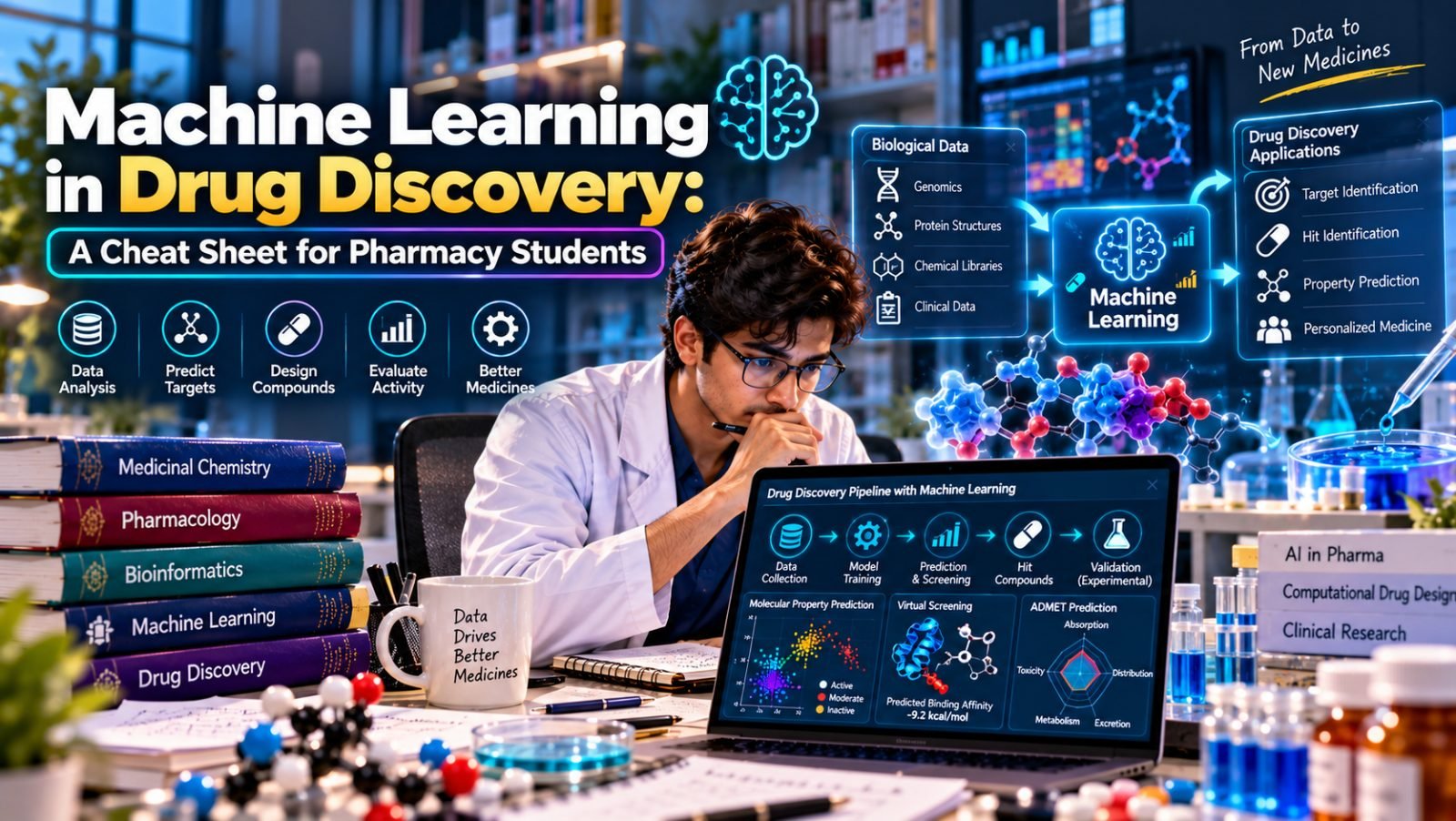
Introduction
Machine learning is a subset of artificial intelligence that has revolutionized various industries, including pharmaceutical sciences. In drug discovery, machine learning algorithms can analyze large datasets to identify patterns and predict outcomes, accelerating the development of new medicines. For pharmacy students, understanding machine learning in drug discovery is crucial for their future careers.
A concrete example of machine learning in drug discovery is the use of predictive modeling to identify potential drug targets. Researchers can use machine learning algorithms to analyze genomic data and identify genes associated with a particular disease, leading to the development of targeted therapies.
What it is / what it isn't
Machine learning in drug discovery refers to the use of algorithms and statistical models to analyze data and make predictions or decisions. It is not a replacement for human expertise, but rather a tool to augment and accelerate the drug discovery process. Machine learning can be applied to various stages of drug development, from target identification to clinical trials.
For instance, machine learning can be used to predict the efficacy and safety of a new drug candidate, reducing the need for costly and time-consuming clinical trials. However, machine learning is not a guarantee of success, and results must be validated through experimental testing.
Why it matters for the target audience
Pharmacy students and professionals need to understand machine learning in drug discovery to stay competitive in the industry. Machine learning is increasingly being used in pharmaceutical research and development, and having a basic understanding of the concepts and techniques is essential for collaboration and communication with other professionals.
A specific scenario where machine learning matters for pharmacy students is in the development of personalized medicines. Machine learning algorithms can analyze patient data to identify genetic variations and predict responses to different treatments, allowing pharmacists to provide tailored recommendations.
Key components or steps
The key components of machine learning in drug discovery include data preparation, model selection, training, and validation. Data preparation involves collecting and preprocessing large datasets, while model selection involves choosing the most suitable algorithm for the task at hand. Training and validation involve testing the model on a subset of the data to evaluate its performance.
A table summarizing the key components of machine learning in drug discovery is as follows:
| Component | Description |
|---|---|
| Data preparation | Collecting and preprocessing large datasets |
| Model selection | Choosing the most suitable algorithm for the task |
| Training | Testing the model on a subset of the data |
| Validation | Evaluating the model's performance on a separate dataset |
How it works in practice — a concrete example
A concrete example of machine learning in drug discovery is the use of deep learning algorithms to predict drug-protein interactions. Researchers can use large datasets of protein structures and drug molecules to train a deep learning model to predict the binding affinity of a drug to a specific protein target.
For instance, a study published in the Journal of Medicinal Chemistry used a deep learning model to predict the binding affinity of a set of small molecules to a specific protein target. The model was trained on a large dataset of protein structures and drug molecules, and was able to predict the binding affinity with high accuracy.
Common challenges
Common challenges in machine learning in drug discovery include the availability and quality of data, the selection of suitable algorithms, and the interpretation of results. Large datasets are often required to train machine learning models, and the quality of the data can significantly impact the accuracy of the predictions.
A specific challenge in machine learning in drug discovery is the issue of overfitting, where the model is too complex and fits the noise in the training data rather than the underlying patterns. Techniques such as cross-validation and regularization can be used to prevent overfitting.
Best practices
Best practices in machine learning in drug discovery include the use of cross-validation to evaluate model performance, the selection of suitable algorithms for the task at hand, and the interpretation of results in the context of the underlying biology. It is also important to consider the limitations and potential biases of machine learning models, and to validate results through experimental testing.
A table summarizing best practices in machine learning in drug discovery is as follows:
| Best practice | Description |
|---|---|
| Cross-validation | Evaluating model performance on a separate dataset |
| Algorithm selection | Choosing the most suitable algorithm for the task |
| Result interpretation | Interpreting results in the context of the underlying biology |
| Validation | Validating results through experimental testing |
Common misconceptions
Common misconceptions about machine learning in drug discovery include the idea that machine learning can replace human expertise, or that machine learning models are always accurate. In reality, machine learning is a tool that can augment and accelerate the drug discovery process, but human expertise and validation are still essential.
A specific misconception about machine learning in drug discovery is the idea that machine learning models can predict the efficacy and safety of a new drug candidate with complete accuracy. While machine learning models can make predictions, results must be validated through experimental testing to ensure accuracy.
FAQ — 5 questions readers commonly ask, with detailed answers
Q: What is machine learning, and how is it used in drug discovery?
A: Machine learning is a subset of artificial intelligence that involves the use of algorithms and statistical models to analyze data and make predictions or decisions. In drug discovery, machine learning is used to analyze large datasets to identify patterns and predict outcomes, accelerating the development of new medicines.
Q: What are some common applications of machine learning in drug discovery?
A: Common applications of machine learning in drug discovery include predictive modeling, drug target identification, and personalized medicine. Machine learning can be used to predict the efficacy and safety of a new drug candidate, identify potential drug targets, and tailor treatments to individual patients.
Q: What are some challenges and limitations of machine learning in drug discovery?
A: Challenges and limitations of machine learning in drug discovery include the availability and quality of data, the selection of suitable algorithms, and the interpretation of results. Large datasets are often required to train machine learning models, and the quality of the data can significantly impact the accuracy of the predictions.
Q: How can machine learning be used to improve the efficiency and effectiveness of drug discovery?
A: Machine learning can be used to improve the efficiency and effectiveness of drug discovery by analyzing large datasets to identify patterns and predict outcomes, accelerating the development of new medicines. Machine learning can also be used to identify potential drug targets, predict the efficacy and safety of new drug candidates, and tailor treatments to individual patients.
Q: What are some future directions and opportunities for machine learning in drug discovery?
A: Future directions and opportunities for machine learning in drug discovery include the integration of machine learning with other technologies, such as genomics and proteomics, to improve the accuracy and efficiency of drug discovery. Additionally, machine learning can be used to develop personalized medicines, tailoring treatments to individual patients based on their genetic profiles and medical histories.
Conclusion
In conclusion, machine learning is a powerful tool that is transforming the field of drug discovery. By analyzing large datasets to identify patterns and predict outcomes, machine learning can accelerate the development of new medicines and improve the efficiency and effectiveness of the drug discovery process. Pharmacy students and professionals need to understand the basics of machine learning in drug discovery to stay competitive in the industry and to contribute to the development of new medicines.
A final example of the potential of machine learning in drug discovery is the use of machine learning to develop personalized medicines. By analyzing genomic data and medical histories, machine learning algorithms can predict the response of individual patients to different treatments, allowing pharmacists to provide tailored recommendations. As the field of machine learning continues to evolve, we can expect to see even more innovative applications in drug discovery and development.