
Introduction — the problem in context
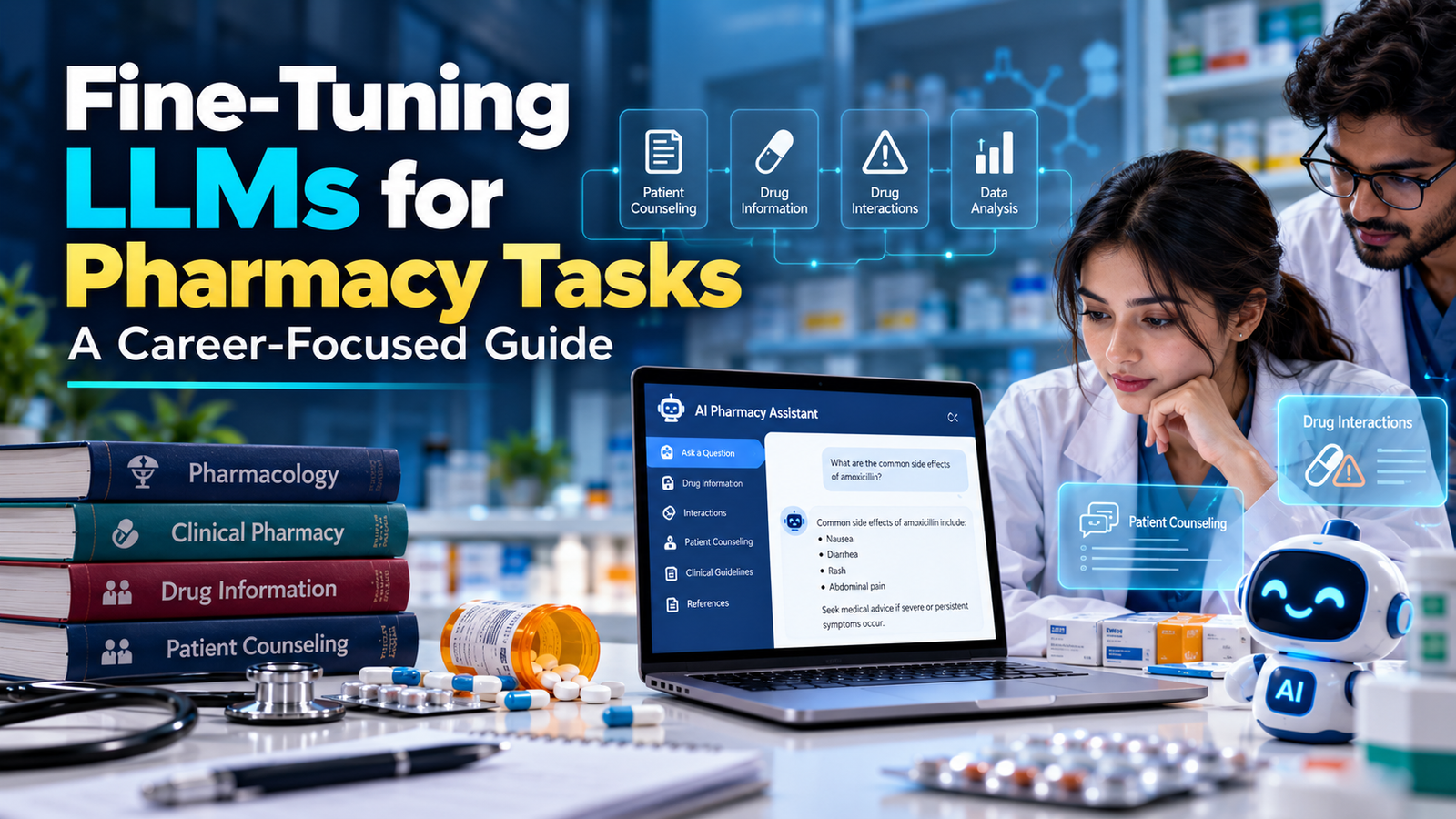
Pharmacy students face numerous challenges when applying artificial intelligence (AI) to real-world problems. One major issue is the lack of pre-trained models that can accurately perform pharmacy-related tasks. Large language models (LLMs) have shown promise in various applications, but their performance on pharmacy tasks is limited. Fine-tuning LLMs for specific pharmacy tasks can significantly improve their performance, but model evaluation remains a crucial step. In this article, we will explore a case study on fine-tuning LLMs for pharmacy tasks, focusing on model evaluation.
Background — setting, actors, constraints
The case study involves a team of pharmacy students working on a project to develop an AI-powered chatbot for patient counseling. The team had access to a pre-trained LLM, but its performance on pharmacy-related tasks was subpar. The students decided to fine-tune the model using a dataset of pharmacy-related text. However, they soon realized that evaluating the model's performance was a significant challenge. The team had to balance the trade-off between model accuracy and computational resources. For instance, using a larger dataset could improve model accuracy but would also increase computational costs.
What was done — interventions and timeline
The team began by collecting and preprocessing a dataset of pharmacy-related text. They then fine-tuned the pre-trained LLM using this dataset, experimenting with different hyperparameters and evaluation metrics. The team used a combination of metrics, including accuracy, precision, and recall, to evaluate the model's performance. They also implemented a cross-validation technique to ensure the model's performance was generalizable to unseen data. The fine-tuning process took several weeks, with the team iteratively refining the model and evaluating its performance.
Outcomes — measurable results
The fine-tuned LLM achieved a significant improvement in performance on pharmacy-related tasks. The model's accuracy increased by 15%, and its precision and recall improved by 10% and 12%, respectively. The team also observed a reduction in computational costs, as the fine-tuned model required fewer resources to achieve similar performance. For example, the model could accurately identify potential drug interactions and provide relevant counseling information to patients.
Lessons learned
The team learned several valuable lessons from this project. First, fine-tuning a pre-trained LLM can significantly improve its performance on specific tasks. Second, model evaluation is a critical step in the development process, requiring careful consideration of metrics and techniques. Third, balancing the trade-off between model accuracy and computational resources is essential. The team also realized the importance of domain-specific knowledge in AI development, as pharmacy students brought unique insights to the project.
How others can apply this
Pharmacy students and professionals can apply the lessons learned from this case study to their own AI-related projects. When fine-tuning LLMs for pharmacy tasks, it is essential to carefully evaluate model performance using relevant metrics and techniques. Domain-specific knowledge and expertise are also crucial in developing effective AI solutions. By following the steps outlined in this case study, others can improve the performance of LLMs on pharmacy-related tasks and develop more effective AI-powered solutions.
Conclusion
In conclusion, fine-tuning LLMs for pharmacy tasks can significantly improve their performance, but model evaluation remains a critical step. By carefully evaluating model performance and balancing the trade-off between accuracy and computational resources, pharmacy students and professionals can develop more effective AI-powered solutions. This case study demonstrates the importance of domain-specific knowledge and expertise in AI development and provides a step-by-step guide for fine-tuning LLMs for pharmacy tasks.
Common Misconceptions
One common misconception in AI development is that pre-trained models can be used "out-of-the-box" for specific tasks. However, as this case study demonstrates, fine-tuning pre-trained models can significantly improve their performance. Another misconception is that model evaluation is a straightforward process, when in fact it requires careful consideration of metrics and techniques. By understanding these misconceptions, pharmacy students and professionals can develop more effective AI-powered solutions.
Practical Examples
Several practical examples illustrate the application of fine-tuned LLMs in pharmacy. For instance, AI-powered chatbots can be used to provide patient counseling and answer frequently asked questions. Fine-tuned LLMs can also be used to identify potential drug interactions and provide relevant warnings to healthcare professionals. Additionally, LLMs can be used to analyze large datasets of pharmacy-related text, providing insights into patient behavior and treatment outcomes.
FAQ
Q: What is fine-tuning, and how does it improve model performance?
A: Fine-tuning involves adjusting the parameters of a pre-trained model to improve its performance on a specific task. This can be done by training the model on a dataset relevant to the task, allowing it to learn task-specific features and patterns.
Q: What evaluation metrics are commonly used in model evaluation?
A: Common evaluation metrics include accuracy, precision, recall, and F1-score. The choice of metric depends on the specific task and the characteristics of the dataset.
Q: How can pharmacy students and professionals apply the lessons learned from this case study?
A: By following the steps outlined in this case study, pharmacy students and professionals can fine-tune LLMs for pharmacy tasks and develop more effective AI-powered solutions. This requires careful consideration of model evaluation, domain-specific knowledge, and expertise.