
Introduction
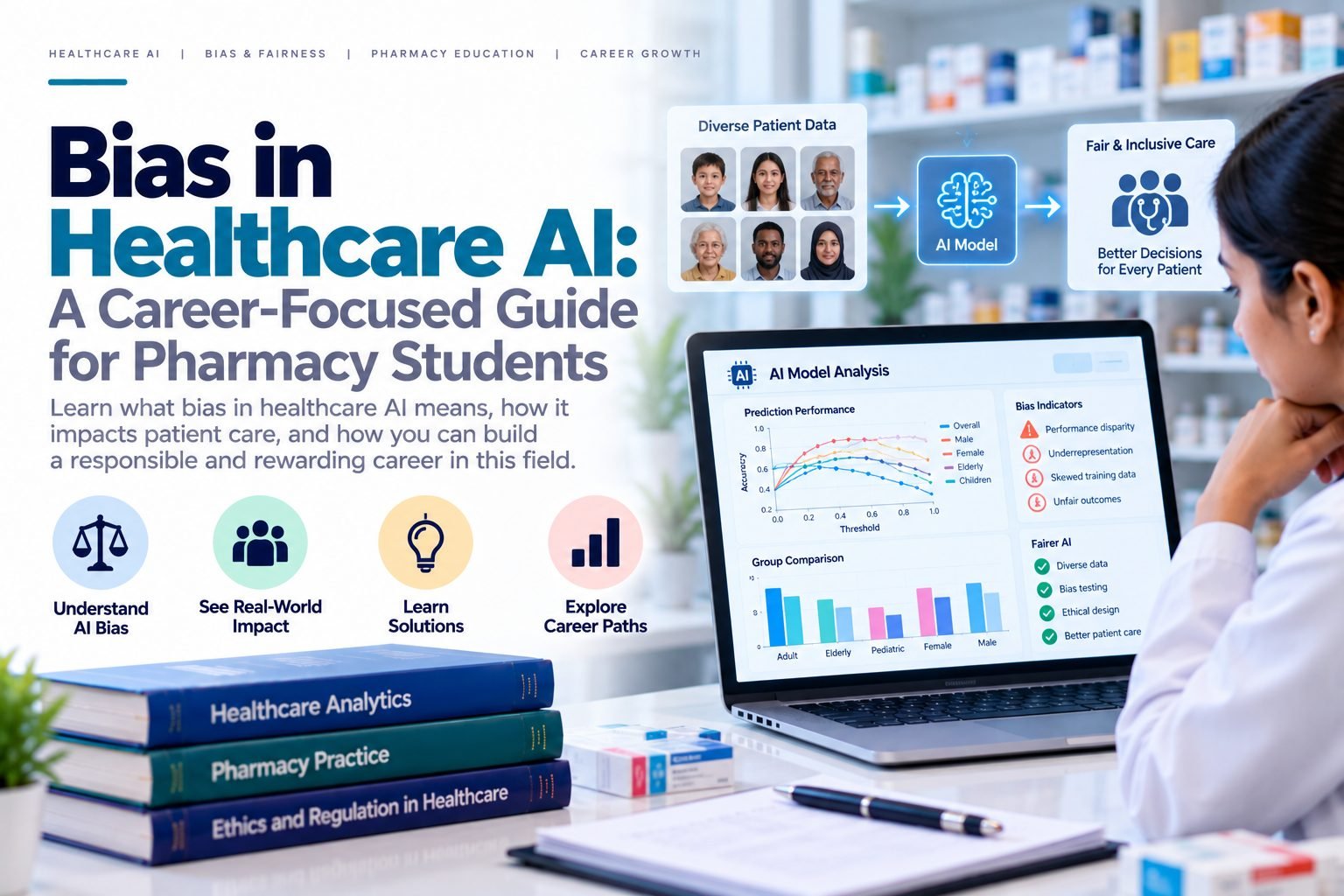
Bias in healthcare AI refers to the systematic errors or deviations in AI decision-making that can result in unequal treatment or outcomes for certain patient groups. As AI becomes increasingly integrated into healthcare, understanding and addressing bias is crucial for ensuring fair and effective patient care. Pharmacy students, in particular, must be aware of the potential for bias in AI systems and learn how to identify and mitigate it.
What it is / what it isn't
Bias in healthcare AI is not the same as inaccuracy or error. While inaccuracy can be due to various factors, such as data quality or algorithmic flaws, bias refers specifically to systematic deviations that affect certain groups disproportionately. For example, an AI system may be biased towards patients with certain demographics, medical conditions, or socioeconomic backgrounds. Understanding the distinction between bias and inaccuracy is essential for developing effective strategies to address bias in healthcare AI.
Why it matters for the target audience
Pharmacy students must understand bias in healthcare AI because they will be working with AI systems in their future careers. Bias can affect patient outcomes, treatment plans, and medication management, all of which are critical aspects of pharmacy practice. Moreover, pharmacy students must be aware of the potential for bias in AI systems to ensure that they are providing equitable and effective care to all patients. By understanding bias, pharmacy students can develop the skills and knowledge needed to identify and address bias in AI systems, ultimately improving patient care and outcomes.
Key components or steps
Addressing bias in healthcare AI requires several key components or steps. First, data quality and diversity are essential for developing unbiased AI systems. This includes ensuring that the data used to train AI models is representative of diverse patient populations and free from biases. Second, AI algorithms must be designed and tested to detect and mitigate bias. This can involve using techniques such as data preprocessing, feature selection, and model regularization. Finally, continuous monitoring and evaluation of AI systems are necessary to detect and address bias as it arises.
How it works in practice — a concrete example
A concrete example of bias in healthcare AI is the use of AI-powered diagnostic systems for cardiovascular disease. Studies have shown that these systems can be biased towards patients with certain demographics, such as age, sex, or socioeconomic status. For instance, an AI system may be more likely to diagnose cardiovascular disease in older patients or those with a family history of the disease, even if they have similar symptoms and medical histories as younger patients or those without a family history. To address this bias, pharmacy students can work with healthcare teams to develop and implement AI systems that are designed to detect and mitigate bias, such as by using diverse and representative data sets or implementing algorithms that account for demographic and socioeconomic factors.
Common challenges
Several common challenges exist when addressing bias in healthcare AI. One challenge is ensuring that data sets are diverse and representative of patient populations. Another challenge is developing AI algorithms that can detect and mitigate bias, particularly in complex and high-dimensional data sets. Additionally, continuous monitoring and evaluation of AI systems can be resource-intensive and require significant expertise. Finally, addressing bias in healthcare AI requires collaboration and communication among healthcare professionals, data scientists, and AI developers, which can be time-consuming and require significant effort.
Best practices
Several best practices exist for addressing bias in healthcare AI. First, data quality and diversity are essential for developing unbiased AI systems. This includes ensuring that data sets are representative of diverse patient populations and free from biases. Second, AI algorithms must be designed and tested to detect and mitigate bias, using techniques such as data preprocessing, feature selection, and model regularization. Third, continuous monitoring and evaluation of AI systems are necessary to detect and address bias as it arises. Finally, collaboration and communication among healthcare professionals, data scientists, and AI developers are essential for developing and implementing effective strategies to address bias in healthcare AI.
Common misconceptions
Several common misconceptions exist about bias in healthcare AI. One misconception is that bias is inevitable or unavoidable in AI systems. However, with careful design, testing, and evaluation, bias can be detected and mitigated. Another misconception is that bias only affects certain patient groups, such as those with certain demographics or medical conditions. However, bias can affect any patient group and can have significant consequences for patient outcomes and treatment plans. Finally, some may believe that addressing bias in healthcare AI is solely the responsibility of data scientists or AI developers. However, addressing bias requires collaboration and communication among healthcare professionals, data scientists, and AI developers.
FAQ — 5 questions readers commonly ask, with detailed answers
- Q: What is bias in healthcare AI, and how does it affect patient care? A: Bias in healthcare AI refers to the systematic errors or deviations in AI decision-making that can result in unequal treatment or outcomes for certain patient groups. Bias can affect patient outcomes, treatment plans, and medication management, ultimately impacting the quality and effectiveness of care.
- Q: How can pharmacy students address bias in healthcare AI? A: Pharmacy students can address bias in healthcare AI by understanding the causes and consequences of bias, developing skills and knowledge to identify and mitigate bias, and collaborating with healthcare teams to develop and implement effective strategies to address bias.
- Q: What are some common challenges when addressing bias in healthcare AI? A: Common challenges include ensuring that data sets are diverse and representative of patient populations, developing AI algorithms that can detect and mitigate bias, and continuous monitoring and evaluation of AI systems.
- Q: What are some best practices for addressing bias in healthcare AI? A: Best practices include ensuring data quality and diversity, designing and testing AI algorithms to detect and mitigate bias, and continuous monitoring and evaluation of AI systems.
- Q: Why is addressing bias in healthcare AI important for pharmacy students? A: Addressing bias in healthcare AI is essential for pharmacy students because it can impact patient outcomes, treatment plans, and medication management, ultimately affecting the quality and effectiveness of care. By understanding and addressing bias, pharmacy students can develop the skills and knowledge needed to provide equitable and effective care to all patients.
Conclusion
In conclusion, bias in healthcare AI is a significant concern that can have far-reaching consequences for patient care and outcomes. Pharmacy students must understand the causes and consequences of bias, develop skills and knowledge to identify and mitigate bias, and collaborate with healthcare teams to develop and implement effective strategies to address bias. By addressing bias in healthcare AI, pharmacy students can help ensure that AI systems are fair, effective, and provide high-quality care to all patients.