
Introduction — Define the Topic and Why it Matters
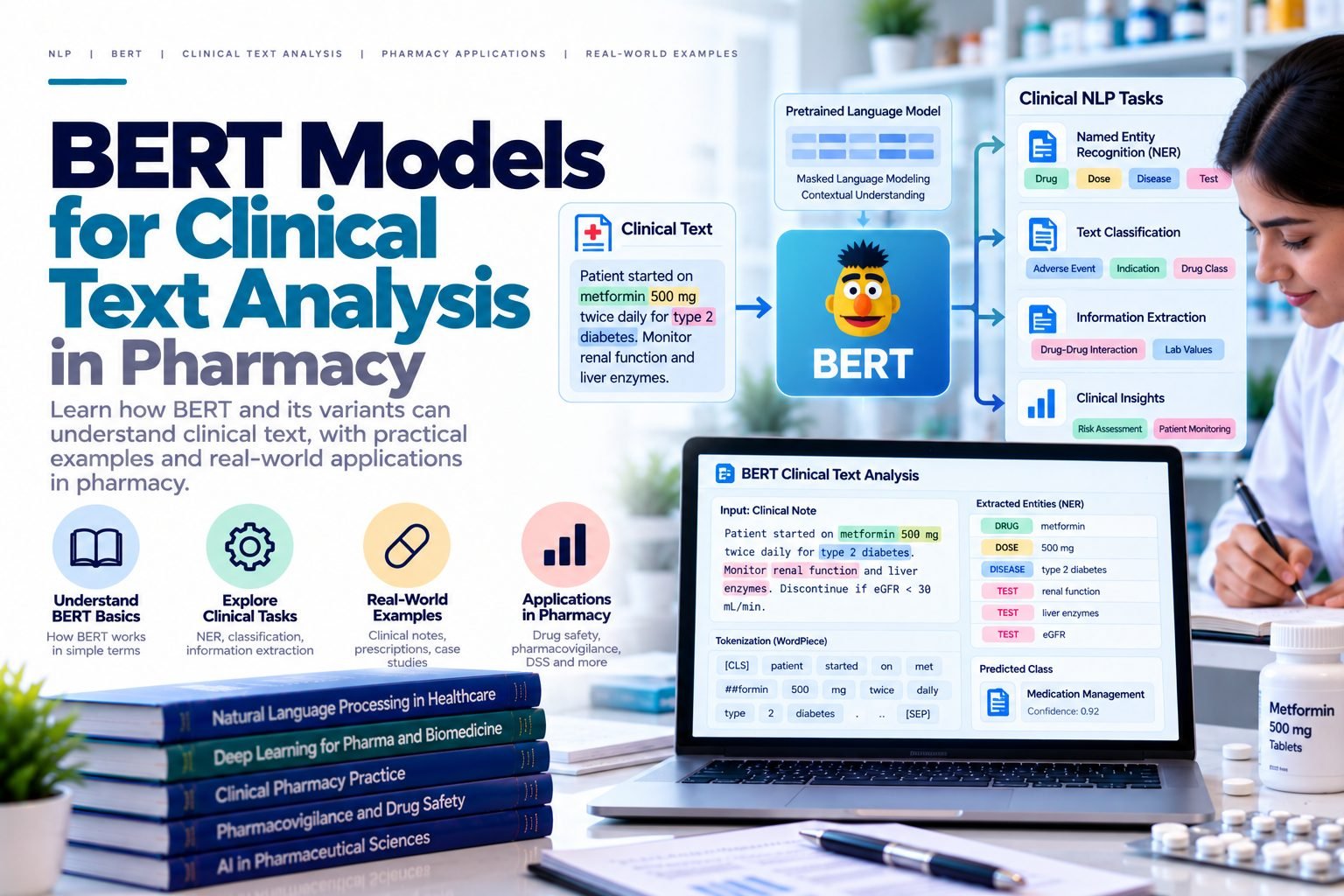
Pharmacy students and professionals must analyze clinical text to provide quality patient care and advance research. BERT (Bidirectional Encoder Representations from Transformers) models, a type of AI, can improve this analysis. BERT's ability to understand context and nuances in language makes it a valuable tool for clinical text analysis.
For example, a pharmacy student can use BERT to analyze medication labels, identifying potential interactions and side effects. This enhances patient safety and care.
What it is / What it isn't
BERT is a pre-trained language model that uses machine learning to understand natural language. It's not a rule-based system, but rather a model that learns from large datasets. BERT is specifically designed for natural language processing (NLP) tasks, such as text classification, sentiment analysis, and question-answering.
BERT isn't a replacement for human judgment, but rather a tool to augment and support clinical decision-making. Pharmacy students should understand the limitations and potential biases of BERT models.
Why it Matters for the Target Audience
Pharmacy graduates preparing for interviews should understand BERT models and their applications in clinical text analysis. This knowledge demonstrates their ability to adapt to new technologies and improve patient care. By applying BERT models, pharmacists can enhance medication therapy management, optimize treatment plans, and improve patient outcomes.
For instance, a pharmacist can use BERT to analyze electronic health records (EHRs), identifying patterns and trends that inform treatment decisions.
Key Components or Steps
The key components of BERT models include the encoder, decoder, and attention mechanism. Pharmacy students should understand these components and how they contribute to the model's performance. The steps involved in applying BERT models include data preprocessing, model selection, and hyperparameter tuning.
A concrete example of applying BERT models involves using the Hugging Face Transformers library to fine-tune a pre-trained BERT model for a specific clinical text analysis task.
How it Works in Practice — A Concrete Example
A pharmacy student can use BERT to analyze clinical trial reports, identifying potential adverse events and efficacy outcomes. By fine-tuning a pre-trained BERT model on a dataset of clinical trial reports, the student can develop a model that accurately extracts relevant information.
For example, the student can use the `transformers` library to load a pre-trained BERT model and fine-tune it on a dataset of clinical trial reports. The resulting model can be used to analyze new clinical trial reports, identifying potential safety concerns and efficacy outcomes.
Common Challenges
Pharmacy students may encounter challenges when applying BERT models, including data quality issues, model interpretability, and computational resources. Addressing these challenges requires a deep understanding of the BERT model architecture and the clinical text analysis task.
For instance, a student may need to preprocess the data to address missing values or inconsistent formatting. The student may also need to adjust the model's hyperparameters to optimize its performance on the specific task.
Best Practices
Best practices for applying BERT models in clinical text analysis include using pre-trained models, fine-tuning on task-specific datasets, and evaluating model performance using relevant metrics. Pharmacy students should also consider the ethical implications of using BERT models, including potential biases and patient privacy concerns.
A concrete example of best practices involves using the `transformers` library to load a pre-trained BERT model and fine-tune it on a dataset of clinical trial reports. The student can then evaluate the model's performance using metrics such as accuracy, precision, and recall.
Common Misconceptions
Common misconceptions about BERT models include the idea that they are a replacement for human judgment or that they can be used without proper training and validation. Pharmacy students should understand that BERT models are tools that augment and support clinical decision-making, rather than replacing it.
For example, a student may mistakenly believe that a BERT model can be used to analyze clinical text without any human oversight or validation. However, this can lead to errors and potential harm to patients.
FAQ — 5 Questions Readers Commonly Ask
- Q: What is the difference between BERT and other NLP models? A: BERT is a pre-trained language model that uses a multi-layer bidirectional transformer encoder to generate contextualized representations of words in the input text.
- Q: How can I use BERT models for clinical text analysis? A: You can use the `transformers` library to load a pre-trained BERT model and fine-tune it on a dataset of clinical text.
- Q: What are the limitations of BERT models in clinical text analysis? A: BERT models may not perform well on datasets with limited samples or noisy data. They may also require significant computational resources and expertise to fine-tune and deploy.
- Q: Can I use BERT models for other NLP tasks in pharmacy? A: Yes, BERT models can be used for a variety of NLP tasks in pharmacy, including text classification, sentiment analysis, and question-answering.
- Q: How can I evaluate the performance of a BERT model in clinical text analysis? A: You can evaluate the performance of a BERT model using metrics such as accuracy, precision, and recall, as well as more specialized metrics such as F1-score and area under the receiver operating characteristic curve (AUC-ROC).
Conclusion
In conclusion, BERT models are a powerful tool for clinical text analysis in pharmacy. By understanding the key components and steps involved in applying BERT models, pharmacy students can enhance patient care and advance research. However, it's essential to address common challenges and misconceptions, and to follow best practices when using BERT models in clinical text analysis.
By mastering BERT models and their applications in clinical text analysis, pharmacy students can demonstrate their ability to adapt to new technologies and improve patient outcomes. This knowledge will serve them well in their future careers as pharmacists and researchers.