
Introduction
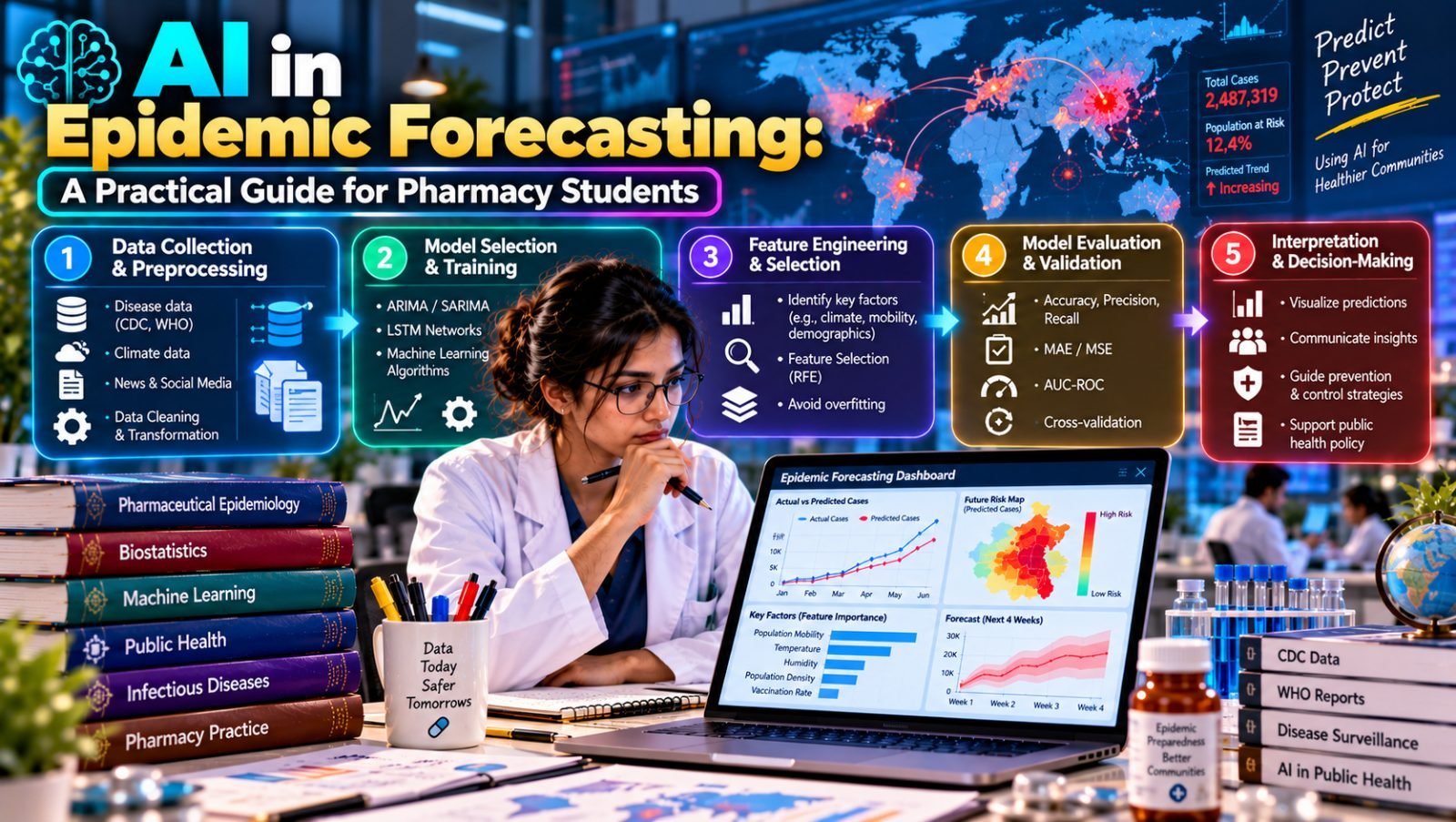
Epidemic forecasting is a critical aspect of public health, and artificial intelligence (AI) has the potential to revolutionize this field. By analyzing large datasets and identifying patterns, AI can help predict the spread of diseases and inform prevention strategies. As pharmacy students, it is essential to understand the role of AI in epidemic forecasting and how to apply these skills in real-world scenarios. This article will provide a step-by-step guide on how to use AI in epidemic forecasting, highlighting common pitfalls and best practices.
1. Data Collection and Preprocessing
The first step in AI-driven epidemic forecasting is data collection and preprocessing. This involves gathering relevant data from various sources, such as disease surveillance reports, climate data, and social media. For example, the Centers for Disease Control and Prevention (CDC) provides a wealth of data on disease outbreaks, which can be used to train AI models. However, it is crucial to preprocess the data by cleaning, transforming, and formatting it to ensure that it is suitable for analysis. A concrete example of this is the use of natural language processing (NLP) to extract relevant information from unstructured data sources, such as news articles and social media posts.
2. Model Selection and Training
Once the data is preprocessed, the next step is to select and train a suitable AI model. There are various machine learning algorithms that can be used for epidemic forecasting, including autoregressive integrated moving average (ARIMA), seasonal ARIMA (SARIMA), and long short-term memory (LSTM) networks. For instance, a study published in the Journal of Infectious Diseases used an LSTM network to predict the spread of influenza in the United States. The model was trained on historical data and achieved high accuracy in predicting future outbreaks. However, it is essential to evaluate the performance of the model using metrics such as mean absolute error (MAE) and mean squared error (MSE).
3. Feature Engineering and Selection
Feature engineering and selection are critical steps in AI-driven epidemic forecasting. This involves identifying the most relevant features that contribute to the spread of diseases and selecting the most informative ones to include in the model. For example, a study published in the journal PLOS ONE found that climate variables, such as temperature and humidity, were significant predictors of dengue fever outbreaks. The study used a feature selection technique called recursive feature elimination (RFE) to identify the most important features. However, it is crucial to avoid overfitting by using techniques such as cross-validation and regularization.
4. Model Evaluation and Validation
Evaluating and validating the performance of the AI model is essential to ensure that it is accurate and reliable. This involves using metrics such as accuracy, precision, and recall to evaluate the model's performance on a test dataset. For instance, a study published in the Journal of Epidemiology and Community Health used a metric called the area under the receiver operating characteristic curve (AUC-ROC) to evaluate the performance of a machine learning model in predicting influenza outbreaks. The model achieved an AUC-ROC of .9, indicating high accuracy. However, it is crucial to consider the limitations of the model and the potential biases in the data.
5. Interpretation and Decision-Making
Finally, the output of the AI model must be interpreted and used to inform decision-making. This involves communicating the results to stakeholders, such as public health officials and policymakers, and providing recommendations for prevention and control strategies. For example, a study published in the journal BMC Public Health used an AI model to predict the spread of COVID-19 in a specific region. The model predicted a high risk of transmission, and the results were used to inform decision-making on lockdown measures and vaccination strategies. However, it is crucial to consider the ethical implications of using AI in epidemic forecasting and to ensure that the results are transparent and explainable.
Which One to Try First: A Decision Guide
For pharmacy students who are new to AI-driven epidemic forecasting, it can be challenging to decide which step to try first. A good starting point is to explore the data collection and preprocessing step, as this involves gathering and cleaning data, which is a critical component of any AI project. Additionally, there are many publicly available datasets and tools that can be used for this step, such as the CDC's dataset on disease outbreaks. Once you have a good understanding of the data, you can move on to the model selection and training step, which involves choosing a suitable algorithm and training the model on the preprocessed data.
Conclusion
In conclusion, AI has the potential to revolutionize epidemic forecasting, and pharmacy students can play a critical role in this field. By understanding the steps involved in AI-driven epidemic forecasting, including data collection and preprocessing, model selection and training, feature engineering and selection, model evaluation and validation, and interpretation and decision-making, students can develop the skills necessary to contribute to this field. Additionally, by being aware of the common pitfalls and best practices, students can ensure that their AI models are accurate, reliable, and transparent. As the field of AI continues to evolve, it is essential for pharmacy students to stay up-to-date with the latest developments and to consider the ethical implications of using AI in epidemic forecasting.
Common Misconceptions
There are several common misconceptions about AI-driven epidemic forecasting that need to be addressed. One misconception is that AI can predict outbreaks with complete accuracy. While AI can identify patterns and trends in data, it is not a crystal ball, and there are always uncertainties and limitations associated with predictions. Another misconception is that AI can replace human judgment and decision-making. While AI can provide valuable insights and recommendations, human judgment and decision-making are still essential in epidemic forecasting. Finally, some people believe that AI is only useful for predicting large-scale outbreaks, such as pandemics. However, AI can also be used to predict smaller-scale outbreaks, such as those that occur in specific regions or communities.
Practical Examples
There are many practical examples of AI-driven epidemic forecasting in action. For instance, the CDC uses AI to predict the spread of influenza and other diseases. The World Health Organization (WHO) also uses AI to predict the spread of diseases, such as Ebola and COVID-19. Additionally, many research institutions and universities are using AI to develop new models and techniques for epidemic forecasting. For example, a team of researchers at Harvard University developed an AI model that can predict the spread of COVID-19 in specific regions. The model uses a combination of machine learning algorithms and data from various sources, including social media and news articles.
FAQ
Q: What is AI-driven epidemic forecasting? A: AI-driven epidemic forecasting is the use of artificial intelligence algorithms and techniques to predict the spread of diseases. Q: What are the benefits of AI-driven epidemic forecasting? A: The benefits of AI-driven epidemic forecasting include improved accuracy, speed, and scalability, as well as the ability to identify patterns and trends in data that may not be apparent to human analysts. Q: What are the limitations of AI-driven epidemic forecasting? A: The limitations of AI-driven epidemic forecasting include the potential for bias in the data, the need for large amounts of high-quality data, and the risk of overfitting or underfitting the model. Q: How can pharmacy students get involved in AI-driven epidemic forecasting? A: Pharmacy students can get involved in AI-driven epidemic forecasting by taking courses or attending workshops on AI and machine learning, participating in research projects or competitions, and collaborating with researchers or public health officials on AI-driven epidemic forecasting projects.