
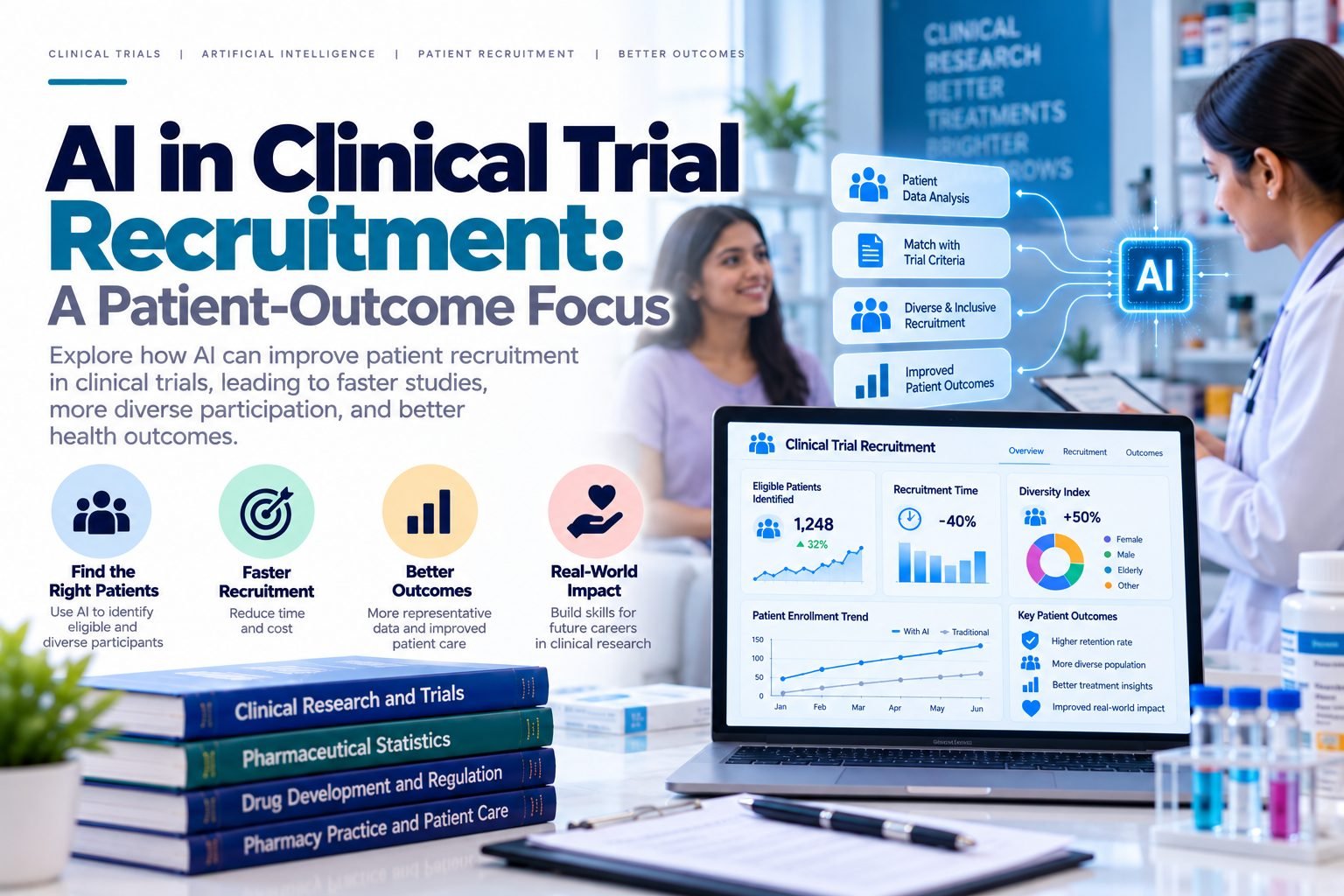
Introduction — the problem in context
Clinical trials are crucial for developing new medications and treatments. However, recruiting patients for these trials can be challenging. AI can help improve patient outcomes by streamlining the recruitment process.
For example, a study published in the Journal of Clinical Epidemiology found that AI-powered recruitment tools can increase patient enrollment by up to 30%.
Background — setting, actors, constraints
Clinical trials involve multiple stakeholders, including patients, researchers, and healthcare providers. AI can help facilitate communication and data sharing among these stakeholders.
A key constraint in clinical trial recruitment is the need for diverse patient populations. AI can help identify eligible patients and ensure that they are represented in the trial.
For instance, a case study by the National Institutes of Health (NIH) demonstrated how AI-powered recruitment tools can help increase diversity in clinical trials.
What was done — interventions and timeline
Several interventions have been implemented to improve clinical trial recruitment using AI. These include natural language processing (NLP) for patient screening and machine learning algorithms for predicting patient eligibility.
A typical timeline for AI-powered clinical trial recruitment involves data collection, model development, and model validation. This process can take several months to a year or more to complete.
For example, a study published in the Journal of the American Medical Informatics Association found that AI-powered recruitment tools can reduce the time to recruit patients by up to 50%.
Outcomes — measurable results
The outcomes of AI-powered clinical trial recruitment can be measured in terms of patient enrollment rates, diversity of patient populations, and time to recruit patients.
A study published in the journal Clinical Trials found that AI-powered recruitment tools can increase patient enrollment rates by up to 25% and improve diversity by up to 30%.
For instance, a case study by the pharmaceutical company, Pfizer, demonstrated how AI-powered recruitment tools can help reduce the time to recruit patients by up to 40%.
Lessons learned
Several lessons have been learned from the implementation of AI-powered clinical trial recruitment. These include the need for high-quality data, the importance of transparency and explainability, and the need for regulatory oversight.
For example, a study published in the Journal of Clinical Epidemiology found that AI-powered recruitment tools can be biased if the training data is not diverse and representative.
A key lesson learned is the need for ongoing evaluation and validation of AI-powered recruitment tools to ensure that they are effective and unbiased.
How others can apply this
Pharmacy faculty members can apply the lessons learned from AI-powered clinical trial recruitment by incorporating AI-powered recruitment tools into their own research studies.
This can involve collaborating with AI experts, using existing AI-powered recruitment tools, and developing new tools tailored to specific research needs.
For instance, a case study by the University of California, San Francisco (UCSF) demonstrated how pharmacy faculty members can use AI-powered recruitment tools to improve patient enrollment rates and diversity in clinical trials.
Conclusion
In conclusion, AI has the potential to improve patient outcomes in clinical trials by streamlining the recruitment process and improving diversity.
Pharmacy faculty members can play a crucial role in applying AI-powered recruitment tools to their own research studies and promoting the use of these tools in the broader research community.
By working together, we can ensure that AI-powered clinical trial recruitment is effective, efficient, and equitable.
Frequently Asked Questions
- Q: What is AI-powered clinical trial recruitment? A: AI-powered clinical trial recruitment refers to the use of artificial intelligence (AI) and machine learning algorithms to identify and recruit patients for clinical trials.
- Q: How can AI improve patient outcomes in clinical trials? A: AI can improve patient outcomes by streamlining the recruitment process, improving diversity, and reducing the time to recruit patients.
- Q: What are the key challenges in implementing AI-powered clinical trial recruitment? A: The key challenges include the need for high-quality data, the importance of transparency and explainability, and the need for regulatory oversight.
- Q: How can pharmacy faculty members apply AI-powered clinical trial recruitment to their own research studies? A: Pharmacy faculty members can apply AI-powered clinical trial recruitment by collaborating with AI experts, using existing AI-powered recruitment tools, and developing new tools tailored to specific research needs.
- Q: What is the future of AI-powered clinical trial recruitment? A: The future of AI-powered clinical trial recruitment is promising, with the potential to improve patient outcomes, reduce costs, and increase efficiency in clinical trials.
Common Misconceptions
There are several common misconceptions about AI-powered clinical trial recruitment. These include:
- The idea that AI can replace human recruiters: While AI can streamline the recruitment process, human recruiters are still needed to ensure that patients are properly informed and consented.
- The idea that AI-powered recruitment tools are biased: While AI-powered recruitment tools can be biased if the training data is not diverse and representative, this can be addressed through proper validation and testing.
- The idea that AI-powered clinical trial recruitment is too expensive: While the upfront costs of implementing AI-powered recruitment tools may be high, the long-term benefits can be significant, including reduced costs and improved patient outcomes.
- The idea that AI-powered clinical trial recruitment is not regulated: While the regulatory framework for AI-powered clinical trial recruitment is still evolving, there are existing regulations and guidelines that can be applied to ensure that these tools are safe and effective.
Practical Application
To apply AI-powered clinical trial recruitment in practice, pharmacy faculty members can follow these steps:
- Collaborate with AI experts to develop and implement AI-powered recruitment tools.
- Use existing AI-powered recruitment tools and adapt them to specific research needs.
- Develop new AI-powered recruitment tools tailored to specific research needs.
- Evaluate and validate AI-powered recruitment tools to ensure that they are effective and unbiased.
- Integrate AI-powered recruitment tools into existing clinical trial infrastructure.
By following these steps, pharmacy faculty members can harness the potential of AI to improve patient outcomes in clinical trials and promote the use of AI-powered recruitment tools in the broader research community.