
Introduction — what we're building and why
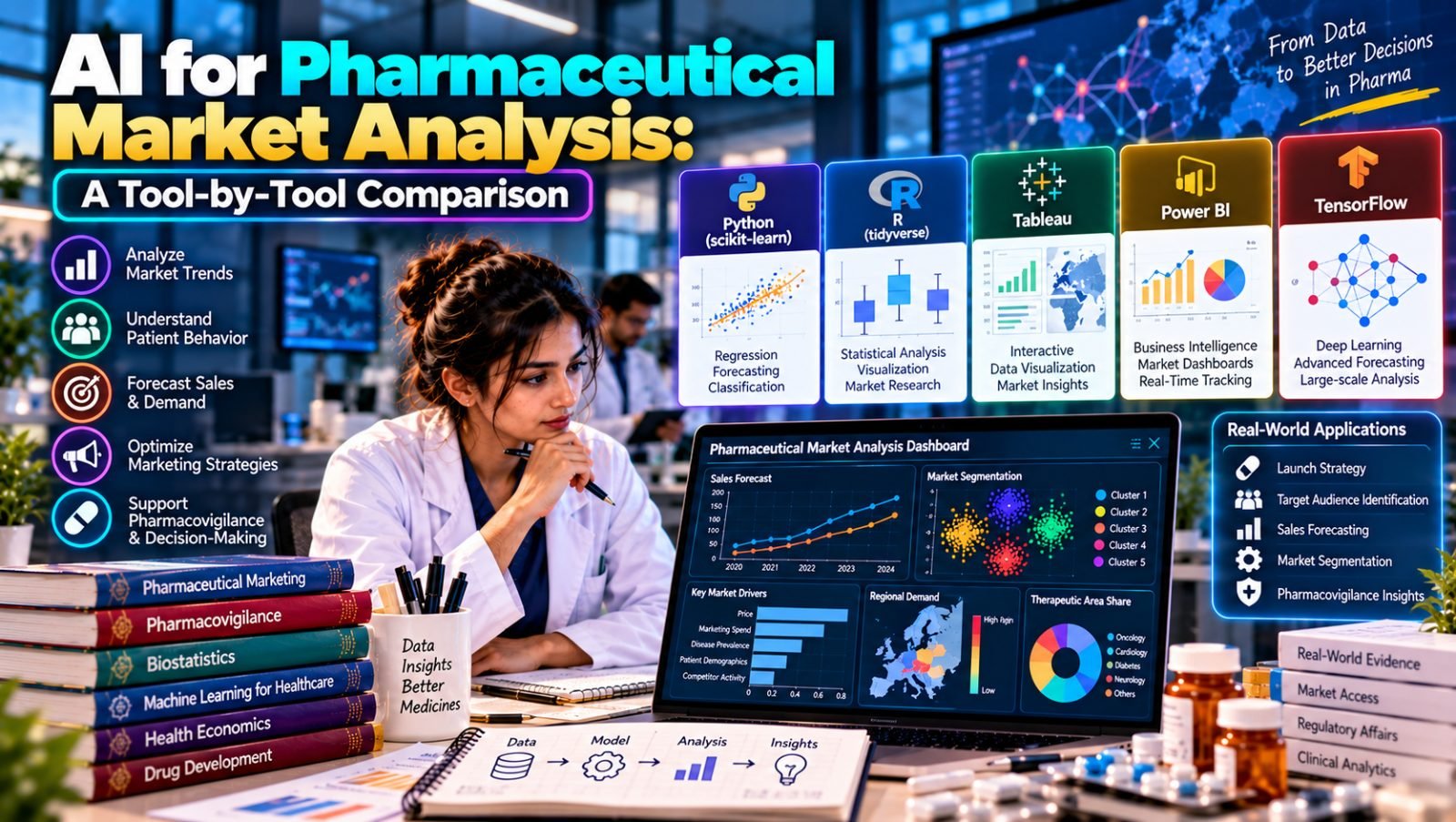
As pharmacovigilance officers, it's essential to stay ahead of the curve in pharmaceutical market analysis. Artificial intelligence (AI) can help us achieve this goal by providing insights into market trends, patient behavior, and drug efficacy. In this tutorial, we'll explore the best AI tools and techniques for pharmaceutical market analysis, with a focus on practical applications and career development.
For example, let's consider a scenario where a pharmaceutical company wants to launch a new drug for a specific disease. By applying AI to market analysis, we can identify the target audience, forecast sales, and optimize marketing strategies.
Prerequisites
To get started with AI for pharmaceutical market analysis, you'll need a solid understanding of machine learning fundamentals, including supervised and unsupervised learning, regression, and clustering. You should also be familiar with programming languages like Python and R, as well as data visualization tools like Tableau or Power BI.
Additionally, it's essential to have a basic understanding of pharmaceutical market dynamics, including regulatory frameworks, market research methods, and pharmacovigilance principles. If you're new to these topics, don't worry – we'll provide links to learning resources throughout this tutorial.
Step-by-step walkthrough with code examples
Let's start with a simple example using Python and the scikit-learn library. We'll build a linear regression model to forecast sales for a new drug based on historical data.
import pandas as pd
from sklearn.linear_model import LinearRegression

# Load historical sales data
data = pd.read_csv('sales_data.csv')

# Define features and target variable
X = data[['price', 'marketing_budget']]
y = data['sales']

# Train linear regression model
model = LinearRegression()
model.fit(X, y)

# Make predictions on new data
new_data = pd.DataFrame({'price': [10, 20, 30], 'marketing_budget': [100, 200, 300]})
predictions = model.predict(new_data)
print(predictions)
This code snippet demonstrates how to build a simple linear regression model using scikit-learn. We'll explore more advanced techniques, including neural networks and clustering, in subsequent sections.
Common errors and how to fix them
When working with AI for pharmaceutical market analysis, common errors include overfitting, underfitting, and data quality issues. To avoid these pitfalls, it's essential to validate your models using techniques like cross-validation and to carefully preprocess your data.
For example, let's consider a scenario where our linear regression model is overfitting due to noisy data. We can address this issue by applying regularization techniques, such as L1 or L2 regularization, to reduce model complexity.
from sklearn.linear_model import Ridge

# Define Ridge regression model with L2 regularization
model = Ridge(alpha=.1)
model.fit(X, y)
This code snippet demonstrates how to apply L2 regularization using the Ridge regression algorithm. We'll explore more advanced regularization techniques, including dropout and early stopping, in subsequent sections.
Best practices for production use
When deploying AI models for pharmaceutical market analysis in production, it's essential to follow best practices, including model validation, monitoring, and maintenance. This includes tracking model performance over time, updating models with new data, and addressing potential biases or errors.
For example, let's consider a scenario where our AI model is deployed in a production environment and is used to forecast sales for a new drug. We can monitor model performance by tracking key performance indicators (KPIs) like mean absolute error (MAE) or mean squared error (MSE).
import matplotlib.pyplot as plt

# Plot model performance over time
plt.plot(mae_values)
plt.xlabel('Time')
plt.ylabel('MAE')
plt.show()
This code snippet demonstrates how to monitor model performance using matplotlib. We'll explore more advanced techniques, including model interpretability and explainability, in subsequent sections.
Where to go next
Now that you've completed this tutorial, you're ready to apply AI to pharmaceutical market analysis in your own career. We recommend exploring additional resources, including online courses, books, and research papers, to deepen your understanding of AI and machine learning.
Some recommended resources include the Machine Learning Specialization on Coursera, the Deep Learning book by Ian Goodfellow, Yoshua Bengio, and Aaron Courville, and the Pharmacovigilance research paper by the World Health Organization.
Common Misconceptions
When working with AI for pharmaceutical market analysis, common misconceptions include the idea that AI can replace human judgment or that AI models are always accurate. In reality, AI is a tool that can augment human decision-making, but it's essential to carefully evaluate and validate AI models to ensure their accuracy and reliability.
For example, let's consider a scenario where an AI model is used to forecast sales for a new drug, but the model is not properly validated. This can lead to inaccurate forecasts and poor decision-making. To avoid this pitfall, it's essential to carefully validate AI models using techniques like cross-validation and to monitor model performance over time.
Practical Examples
Let's consider a scenario where a pharmaceutical company wants to launch a new drug for a specific disease. By applying AI to market analysis, we can identify the target audience, forecast sales, and optimize marketing strategies. For example, we can use clustering algorithms to segment the market based on demographic and behavioral characteristics.
from sklearn.cluster import KMeans

# Define K-means clustering model
model = KMeans(n_clusters=5)
model.fit(data)
This code snippet demonstrates how to apply K-means clustering to segment the market. We can then use this information to develop targeted marketing strategies and optimize sales forecasts.
FAQ
Q: What is the best programming language for AI in pharmaceutical market analysis?
A: The best programming language for AI in pharmaceutical market analysis is Python, due to its simplicity, flexibility, and extensive libraries, including scikit-learn and TensorFlow.
Q: How can I get started with AI for pharmaceutical market analysis?
A: To get started with AI for pharmaceutical market analysis, you should start by learning the basics of machine learning, including supervised and unsupervised learning, regression, and clustering. You can then explore additional resources, including online courses, books, and research papers, to deepen your understanding of AI and machine learning.